Showing posts with label microsoft. Show all posts

16 November 2017

If you want to be around for 140 years you must be willing to change!

Last year, GE CEO Jeff Immelt and Satya Nadella, CEO of Microsoft discussed why General Electric one of the world's largest industrial companies was becoming a digital company!


"When you realize the jet engines you produce have sensors that produce more than a terabyte of information on each flight, you begin to realize you already are a digital company with the need for an industrial strength cloud based system to process and deliver the information you have collected."


12 February 2017

FUTURE TRENDS - Concerns Grow as Facial Recognition Software Use Expands

Facial recognition software is a fact of daily life in today’s hybrid digital/physical world.

Some uses are fully consensual and informed, such as enabling (or not) the Microsoft Hello feature.

Other uses, in fact most uses, are more ambiguous when it comes to users’ ability to control when and how facial recognition is used.

Facial recognition in photo software is already notorious for causing problems.

Automatic tagging and facial recognition is meant to save time and make it easier to share your photos with the people in them.

Auto-tagging is a privacy concern, especially for professionals who need to keep their private lives and professional lives strictly separated.

This is a difficult task, and social media makes it more challenging every year.

It’s possible to opt-out of Facebook’s auto-tagging feature, but unless you go through the process of manually opting out, you have no way to control how many photos you’ll find yourself tagged in.

Privacy issues aren’t the only concern when it comes to auto-tagging.

Google has gotten into trouble for a problem in the auto-tagging algorithm that tagged two Black individuals as “gorillas.”

Google isn’t the only software with a race issue, and it’s not the most worrisome, either.

Facial recognition software used by law enforcement has been shown to be significantly less accurate when identifying black individuals, with a match rate that is 5 to 10 percent less accurate than the match rate for white individuals.

Racial bias in photography technology is nothing new, but this problem in facial recognition software used by law enforcement has the potential to cause serious problems for people who do not realize they are even being monitored by the software.

There are nearly 250 million surveillance cameras worldwide, recording people’s movements and faces in areas such as public spaces, streets, stores, and private property.

The software that searches these recordings has become significantly more sophisticated, and the rules about who can access surveillance in order to run facial recognition software are still murky.

Not knowing when you are being entered into a database, or searched through facial recognition databases, is another concern.

A new app released in Russia called FindFace allows users to take a picture of a stranger on the street and the app will search millions of photos on social media to find out who they are.

While this could be used innocently to find missed connections, the risk of abuse by stalkers and abusers is significant.

As Fortune magazine put it, this is a “facial recognition nightmare.”

And abuse by strangers isn’t the only concern. Misuse by law enforcement is also an issue.
 
A 2016 report by the Georgetown Law Centre on Privacy and Technology calls the use of facial recognition software by law enforcement “the perpetual line-up” and highlights the risks to civilian privacy.

According to The Intercept, in an article that unpacks the report and interviews authors and stakeholders, the report “reveals that police deploy face recognition technology in ways that are more widespread, advanced, and unregulated than anyone has previously reported.”

British filmmaker Karen Palmer created an interactive film and protest simulation to demonstrate how facial recognition software can be used to track protesters, and to point out how easily facial recognition software can be used to surveille in secrecy, and at a distance.

The use of facial recognition software by law enforcement and government is currently unregulated in most jurisdictions, and that’s a major concern for privacy.

This is a growing concern, particularly in America right now.

Both citizens and legislators will have to address issues around the rights to privacy, to free association, and to anonymity.

As always, the balance between personal freedom and governmental control will be tricky, but the software is here to stay, so it’s an issue that will demand a response.


About Tiffany Sostar
Tiffany is a writer, editor, academic, and animal lover who came late to her appreciation of pets. At 18, a rescue pup named Tasha saved her from a depression and she hasn't looked back. She has worked as the canine behaviour program coordinator for the Calgary Humane Society, and was a dog trainer specializing in working with fearful and reactive dogs for many years. She doesn't have any pets right now, but makes up for it by giving her petsitting clients (and any dogs she comes across on her frequent coffee shop adventures) extra snuggles.

29 January 2017

BUSINESS - Apple Joins Other Tech Giants in Artificial Intelligence Partnership

Partnership on AI was formed in 2016 and while Apple was involved since the beginning, the corporation became an official founding member this week.
 
Apple joins a group that includes some of the biggest names in tech - Amazon, DeepMind/Google, Facebook, IBM, and Microsoft.

The growth in artificial intelligence (AI) products, and concerns about potential risks prompted the formation of Partnership on AI whose goal is to ensure that applications of AI are beneficial to people and society.

The organization will study the potential societal impact of AI systems, develop and share best practices, develop educational resources and host open forums to share information about the latest topics in the field.

They will also create working groups for different sectors, for example healthcare and transportation, conducting research on the specific AI applications in these different areas of the economy.

Some fears surrounding AI include criminal use, robots taking over the workforce, privacy, and even the end of the human race.

Many believe, however, AI machines and applications are the next generation of sophisticated tools enhancing our human capabilities.

The aim of Partnership on AI is to help ensure the positive application of artificial intelligence.

According to their website, “Diversity of thought across the organization is crucial to ensure that we effectively explore and address the influences of AI on people and society, provide guidance on AI best practices, and seek to advance the public’s understanding of AI.”


05 July 2016

EDITORIAL - SalesForce Bid Increased Microsoft's Cost per LinkedIn Member/Subscriber

According to details released on Friday, a bidding war with Salesforce.com increased the cost Microsoft paid for LinkedIn by nearly US$6 Billion.


As InfoStream reported earlier, no matter how you attribute the cost of the LinkedIn acquisition, the cost (433 million LinkedIn Members @US$60, 105 million Active Members @US$254 or 2 million Paying Subscribers @US$13,000) of acquiring a member/subscriber based enterprise has increased rather dramatically.

The casual observer may wonder why this increased value and interest in member or subscriber driven enterprises. The reader may find the answer surprising.

Instead of reducing the cost of client acquisition, the Internet has actually driven expenses higher and made many campaigns less effective.

There are several reasons for this: The number of 'channels' increased substantially further fragmenting the audience and increasing the cost to reach consumers; The promise of big data and campaigns using SEO or SEM tactics did not anticipate a dramatic move to mobile devices where these tactics are much less effective; The rising skepticism of the mobile consumer who values authenticity and self discovery over 'blast and cast' voucher, coupon and discount campaigns; and finally, The agility of the member/subscriber based enterprise to respond to 'trending' consumer demand with speed (time to market), trust (brand confidence) and the reduction or elimination of market-wide campaigns (lower direct cost, higher margin).

In the war rooms of content and media channels, advertising agencies and marketing departments there is consternation and confusion about what to do next.

Against this backdrop, the idea of acquiring an existing base of 'members or subscribers' may be seen as the least cost, most timely and therefore the most financially efficient method of developing or increasing the number of customers that can be exposed to a brand's product or services.

Organizations that develop members or subscribers in a trusted ecosystem are therefore accorded the highest value by brands who wish to expose their services or products to prospective clients.

About Executive Producer, Larry R. Evans:
Larry Evans is a futurist, a brand developer and a collaboration advocate. He is Principal of The Paradigm Corporation, which is headquartered at Thunder Ridge just outside Crossfield, Alberta, Canada. He is known for bringing a unique and predictive lens to paradigm shifts during a career that spans 45 years. Now from his wheel chair, he brings a grounded, tenacious view of brand, client rights and trusted relationships for the digital age. His perspective and values influence his life, business and ministry.

15 June 2016

Beware Those Who Don't Get the Microsoft-LinkedIn Deal

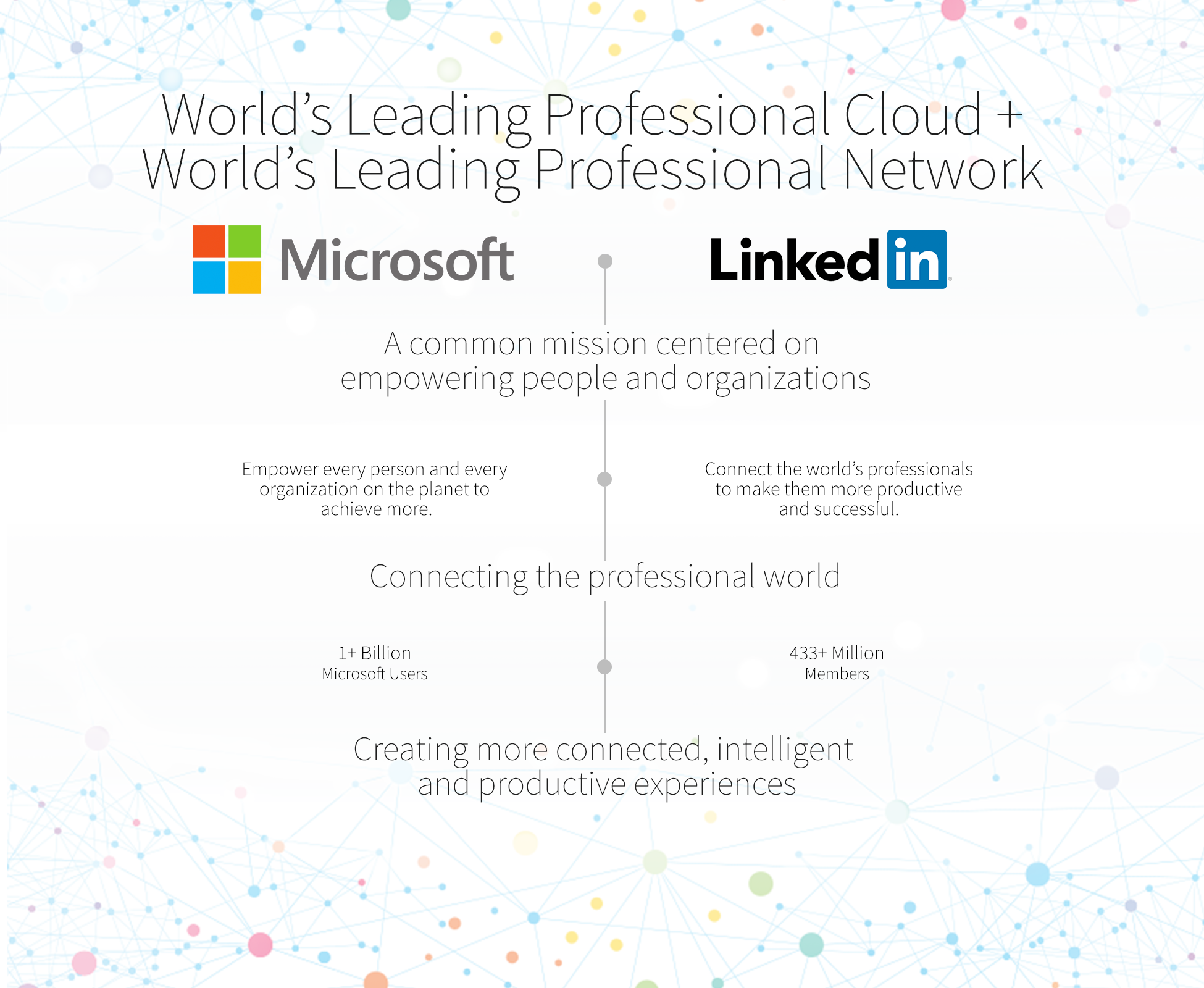
The graphic accompanying the announcement of the Microsoft/LinkedIn deal showed the World's leading professional Cloud and the World's leading professional Network collaborating to create a more connected, intelligent and productive experience.


However, post announcement analysis includes a number of nay-sayers. 

Peter Bright of ARS Technica wrote, "I’ve slept on it—I’m still baffled at Microsoft buying LinkedIn for US$26.2B. Microsoft is buying the cow when all it wants is some milk." He goes on to reflect upon the dismal record of other Microsoft purchases and the dismal performance (GAAP) of LinkedIn.

There are other similar opinions being expressed. Perhaps they have missed the fact the world has changed. Acquisitions in the emerging digital economy have little to do with GAAP or other legacy paradigms and much to do with time to market, cost of acquisition and the need to improve the experience or gain the trust of those who can be served.

The Canadian acquisition of Wind Mobile by Shaw late last year was puzzling to some analysts who examined the free cash flow of some 940,000 Wind subscribers (CA$18/mth) against the CA$1.6 billion cost of acquisition (CA$1,700+/subscriber). Perhaps they missed Shaw's need for a fast tactical and strategic realignment to the small screen. History will likely prove Shaw's acquisition was also a sound financial decision since acquiring subscribers exhausts time and resources like no other business investment.

Earlier today a comment about the Microsoft deal on the Harvard Business Review forum provided a different view. Doug Laney, VP and Distinguished Analyst, Chief Data Officer Research and Advisory, Gartner, suggests Microsoft may have stolen LinkedIn. At $26.2B or US$60.51/user Microsoft is paying less than investors valued both Facebook ($80.95/user) and Twitter ($101.70/user) at the time of their IPOs.

Other information appearing around the Microsoft/LinkedIn transaction provide clues about sources of revenue as well as the size and characteristics of LinkedIn's subscriber base: 433 million users on record, 105 million active members and 2 million paid subscribers. 

Investors should be cautious with financial advisers who don't understand this deal. The information available from LinkedIn may be a useful resource to model and evaluate other emerging networks they find interesting. 

We expect there will still be a strong return on investment and much opportunity for both Microsoft and LinkedIn to explore as they move forward.

About Executive Producer, Larry R. Evans:
Larry Evans is a futurist, a brand developer and a collaboration advocate. He is Principal of The Paradigm Corporation, which is headquartered at Thunder Ridge just outside Crossfield, Alberta, Canada. He is known for bringing a unique and predictive lens to paradigm shifts during a career that spans 45 years. Now from his wheel chair, he brings a grounded, tenacious view of brand, client rights and trusted relationships for the digital age. His perspective and values influence his life, business and ministry.

13 June 2016

Microsoft Pays $60+ per Member to buy LinkedIn

Adding LinkedIn's 105M active monthly users to Microsoft


This morning we learned of one of the largest deals to be made in the history of Microsoft. In a cash deal worth more than USD26 Billion, Microsoft has agreed to purchase LinkedIn. Paying a premium of 49% over the trading price, Microsoft's offer represents USD196 per share or more than USD60 for each of the 433 million LinkedIn members. When the deal is approved by regulators, LinkedIn will become an independent unit within Microsoft, lead by LinkedIn chief executive, Jeff Weiner.

A quick analysis of the research data shows 24% of LinkedIn's 433 million members are reported active on a monthly basis. This means Microsoft has paid about USD249.52 per active subscriber/member. Further analysis of the data may be necessary to determine the number of premium subscribers and regular members that actually stay in place through the transition.

Microsoft stock dropped today, as investors expressed skepticism about the deal, the lack of profitability at LinkedIn and/or recent hacks of LinkedIn data. However, analysts have generally taken a positive view of this transaction.

"The acquisition makes sense in respect of Microsoft's link with enterprise in its cloud platform and portfolio of enterprise business services," professor Mark Skilton of Warwick Business School said in a CBC interview. "It will help Microsoft build out its enterprise services capabilities."

Marvin Ryder, an assistant professor at McMaster University's DeGroote School of Business as quoted by CBC said, "This is the way the world is going. Everything is  moving toward some kind of social media. If you're not there, like if you don't have something on mobile, you can't really compete. This positions them (Microsoft) for 2020 and beyond."

Mike Murphy writer for the online channel Quartz noted that two-thirds of LinkedIn’s USD2.9 billion in revenue last year came from services sold to human resources departments to find the right candidates for job openings, a business LinkedIn calls "Talent Solutions.”


Microsoft had earlier attempted to acquire Salesforce but as Murphy notes, they already have a software platform, branded Dynamics which mimics Salesforce. LinkedIn already is a go-to site for salespeople looking to learn more about clients, leads, and companies. Now LinkedIn will be part of a suite of products that Microsoft’s salespeople can hawk to business customers.


Microsoft CEO Nadella wrote in his email to Microsoft employees: "This deal brings together the world’s leading professional cloud with the world’s leading professional network. I have been learning about LinkedIn for some time while also reflecting on how networks can truly differentiate cloud services. It’s clear to me that the LinkedIn team has grown a fantastic business and an impressive network of more than 433 million professionals."

"Think about it: How people find jobs, build skills, sell, market and get work done and ultimately find success requires a connected professional world. It requires a vibrant network that brings together a professional’s information in LinkedIn’s public network with the information in Office 365 and Dynamics." 

"As these experiences get more intelligent and delightful, the LinkedIn and Office 365 engagement will grow. And in turn, new opportunities will be created for monetization through individual and organization subscriptions and targeted advertising," he stated.

Watch the Interview with Microsoft's Nadella and LinkedIn's Weiner


As an active LinkedIn member almost since the beginning and for the past three years a Premium subscriber I can attest the service has been very useful. It isn't surprising to me that Microsoft would find the company attractive. 

However, the most interesting aspect of this deal is the value Microsoft has placed on the subscriber/members they are acquiring with little or no subscriber revenue. It is becoming increasingly common for large brands to acquire active residual subscriber/members for cash. The development of subscriber/members takes more time and more money than an agile brand in the new economy can afford. In my opinion, the competition for trusted subscriber/member relationships has only just begun.


About Executive Producer, Larry R. Evans:
Larry Evans is a futurist, a brand developer and a collaboration advocate. He is Principal of The Paradigm Corporation, which is headquartered at Thunder Ridge just outside Crossfield, Alberta, Canada. He is known for bringing a unique and predictive lens to paradigm shifts during a career that spans 45 years. Now from his wheel chair, he brings a grounded, tenacious view of brand, client rights and trusted relationships for the digital age. His perspective and values influence his life, business and ministry.

04 May 2016

DIGITAL - Google Chrome Now Top Web Browser

Computerworld recently reported that Microsoft Internet Explorer (IE) lost the number one web browser spot for the first time in its 21 year history and Google Chrome took over.

Data from U.S. analytics vendor Net Applications showed a 2 percentage point drop in April, the fifth straight month with a loss greater than a point for IE.

IE ended the month with 41.4% of the total global browser user share while Chrome climbed 2.6 percentage points to take the lead with 41.7%.

Many believe IE’s decline began when they forced users to upgrade to a newer version if they wanted to continue to receive security patches. Since that announcement, IE lost 17.1 percentage points of user share.

Mozilla Firefox’s global user share also dropped - to below 10% for the first time since 2006.

There had been a number of predictions about the rise of Google Chrome so taking the number one spot was not a complete surprise, other than it happening a bit sooner than some anticipated.


(Computerworld)

02 February 2016

BUSINESS - Alphabet (Google) Most Valuable Public Company in the World

.

With a market capitalization of US$565 billion (+/-) Alphabet moves past Apple the former leader at US$539 billion.


Alphabet Inc. (Google) released its quarterly earnings report after the market closed yesterday and moved past Apple to become the world’s most valuable public company.

What does this mean? With the huge shift in economic and market paradigms it is becoming obvious that capital is moving away from devices toward ecosystems and services. Those who seek funding and those who invest need to pay close attention to where capital moves so they are not disadvantaged.

Furthermore, those involved in manufacturing, distribution and retail must also understand the meaning of this revolution. If capital is rewarding those who help consumers discover products and services more than those who produce, there are large implications for investments in technology, marketing, communications and media.

While Apple blames a slow quarter, the evidence suggests Alphabet was moving ahead since reporting its second quarter profit in July, 2015. Since then Alphabet has risen 28% while Apple’s shares have fallen 25%. Moreover, Alphabet continues to beat the Wall Street projection. Meaning the market guru's have been slow to respond to the shift in the flow of capital.

According to S&P's Silverblatt, achieving this milestone makes Alphabet the 12th company to achieve the title of most valuable company in the history of the index. Apple became the 11th company in August 2011. Other companies have also held the crown. They include Exxon (XOM -2.54%), IBM (IBM -1.45%) and Microsoft (MSFT -2.61%). Surely this places ecosystem and services ahead of energy, machines and software.

While Google executives hear the footsteps of large social media players like Facebook, it must be satisfying to see that building the largest ecosystem in the world has made them the market leader. Small emerging companies who are building ecosystems with the trust of an active subscriber base are on the right track. The patient building of subscriber services will be rewarded as capital gets wise and moves toward them.

20 March 2015

Microsoft to phase out Internet Explorer

The end is in sight for long fraught Windows browser, Internet Explorer. Microsoft announced earlier this week it will phase out Internet Explorer beginning with Windows 10. 

READ MORE: Microsoft is putting Internet Explorer out to pasture

Once a market leader with as much as 95 per cent usage share when it peaked in 2002, Microsoft's flagship browser has experienced a steady decline in its user base since Mozilla Firefox and Google Chrome hit the scene in 2004 and 2008 respectively. Today, Internet Explorer holds just eight per cent of global Internet traffic. 

Microsoft said it will replace Internet Explorer with a new browser codenamed Project Spartan, though Explorer would live on in some capacities, mainly for enterprise compatibility. 

READ MORE: Microsoft is killing off the Internet Explorer brand

InfoStream's "all-time" statistics of traffic sources reveal Internet Explorer holding 27 per cent usage, though that number drops to 12 per cent for the most recent monthly time period.

InfoStream traffic source
statistics for Feb-March 2015
InfoStream traffic source
statistics for All Time


26 January 2012

Android's share of tablet market jumps


Related Stories

According to a report appearing on the BBC, the Android operating system's share of the global tablet computer market has risen sharply at the expense of Apple's iOS.
Tablet computers
Android accounted for 39% of the market in the final three months of last year, up from 29% a year earlier, Strategy Analytics said. Apple's share fell to 58% from 68%.
Microsoft's share stood at 1.5%.
Shipments of tablets reached 26.8 million in the quarter, up from 10.7 million a year ago.
"Demand for tablets among consumer, business and education users remains strong," said Strategy Analytics' Peter King.
Apple shipped 15.4 million iPads between October and December. That compares with shipments of 10.5 million tablets using Android.
For 2011 as a whole, shipments hit 66.9 million, up from 18.6 million in 2010.