Showing posts with label business trends. Show all posts

17 February 2017

DIGITAL - App Trends, What You Need to Know

The mobile app economy was expected to grow rapidly, but not quite as quickly as it has.

Many corporations are now behind the eight ball, thinking there was more time to move into the mobile market.

A report by App Annie predicts the mobile app economy will double in size to $101 billion by 2020.

According to their 2016 Retrospective, “In 2016, the mobile market maintained strong momentum and saw significant growth in usage, downloads and revenue. Worldwide downloads exceeded 90 billion, an increase of more than 13 billion across the iOS App Store and Google Play.”

The retrospective examines the key trends driving the growth of the app economy, and takes a closer look at some of the stand-out countries, categories and apps.

Download the complimentary report to learn about:
  • The emerging markets that that are growing by leaps and bounds for downloads and usage, and the factors behind their increases.
  • The monetization opportunity that exists for publishers worldwide, and the countries seeing the largest gains.
  • Top industries — like media and entertainment, social media, retail and retail banking — that are being transformed by mobile apps, and the trends they must embrace to stay ahead of the competition.
  • How mobile gaming continues to evolve, led in 2016 by the juggernaut that is Pokémon GO.

App Annie is also offering a free webinar on Wednesday, February 22nd: 2016’s App Trends - What You Need to Know which examines the facts presented in the retrospective in detail.

App Annie analysts will answer attendees questions and talk about:
  • The continued, steady growth of the app economy in 2016
  • How mobile is disrupting and transforming traditional industries
  • The changing landscape of mobile gaming and the prominent apps that contributed to these changes
  • How to translate 2016’s findings into actionable items for your 2017 mobile strategy.


10 February 2017

BUSINESS - Mindfulness: a Major Business Trend

Mindfulness is big business, and big in business.

A wealth of apps, coaches, books, and other resources specifically for business people have become available in recent years.

In 2015, meditation and mindfulness was a 1 billion dollar business, and that figure doesn’t account for the revenue generated by the growing number of apps.

Not only are individual business leaders embracing mindfulness as part of their business and leadership practices, but companies such as Google and EBay have incorporated mindfulness-enhancing internal courses and dedicated meditation spaces for their employees.

Rick Titan, a mindfulness coach in Calgary, Alberta, suggests that the reason businesses are investing in mindfulness across organizational levels is because mindfulness allows a person “to be able to get centered and focused, so that you have less of a scattered mind.”

Distracted employees cost businesses a substantial amount in lost time and productivity, with the average distraction (for a phone call, text, or social media check) costing up to 25 minutes of concentration.

That’s bad for business, but it’s also bad for employees’ emotional and mental health.

Constantly being interrupted has negative outcomes for job satisfaction, and it’s possible that mindful workplaces are less likely to be full of the interruptions that can lead to the downward spiral of lost focus and reduced motivation.

One 2014 study by the UNC Kenan-Flagler Business School found that mindfulness at work reduced employee absenteeism and turnover, improved employee productivity and cognitive function, enhanced relationships between employees and employers and between businesses and clients, and improved job satisfaction.

These benefits are only possible if employees feel engaged in the process, rather than pressured.

Incorporating mindfulness in the workplace is a more complex issue than simply mandating regular meditation.

Titan suggests that mindfulness is best learned with the help of a coach, or even a monk.

But for individuals who want an app for that, there are plenty available.

The important thing, according to Titan, is to incorporate regular mindfulness practice, even if your main focus is improving your business life.

He says, “In business you’re rushing around a lot, and it’s really good to get into that mindfulness zone and practice focused meditation regularly rather than trying to do it last minute before doing business. It’s like working out - you exercise a muscle, and you get better at it. It just takes a little bit of time and experience to see the best results.”

The benefits of mindfulness are both personal and professional, and mindfulness can even improve business strategy.

According to Titan, “If you’re trying to bring mindfulness into everyday life, you’re trying to be more focused, more present in the moment, less stressed, and in business it’s about achieving a goal and being able to focus on what you have to do next, accomplishing things and even getting less scattered before you go into a meeting or a sales pitch.”

Titan’s final word is to “bring your practice into daily life, even if you only do it ten to twenty minutes a day or every second day. Get practiced and get good at it. If you just do it once in awhile, you won’t see the benefits.”

About Tiffany Sostar

Tiffany is a writer, editor, academic, and animal lover who came late to her appreciation of pets. At 18, a rescue pup named Tasha saved her from a depression and she hasn't looked back. She has worked as the canine behaviour program coordinator for the Calgary Humane Society, and was a dog trainer specializing in working with fearful and reactive dogs for many years. She doesn't have any pets right now, but makes up for it by giving her petsitting clients (and any dogs she comes across on her frequent coffee shop adventures) extra snuggles.

27 January 2017

FUTURE TRENDS - Mobile ad Spending Projected to Reach $72 Billion by 2020

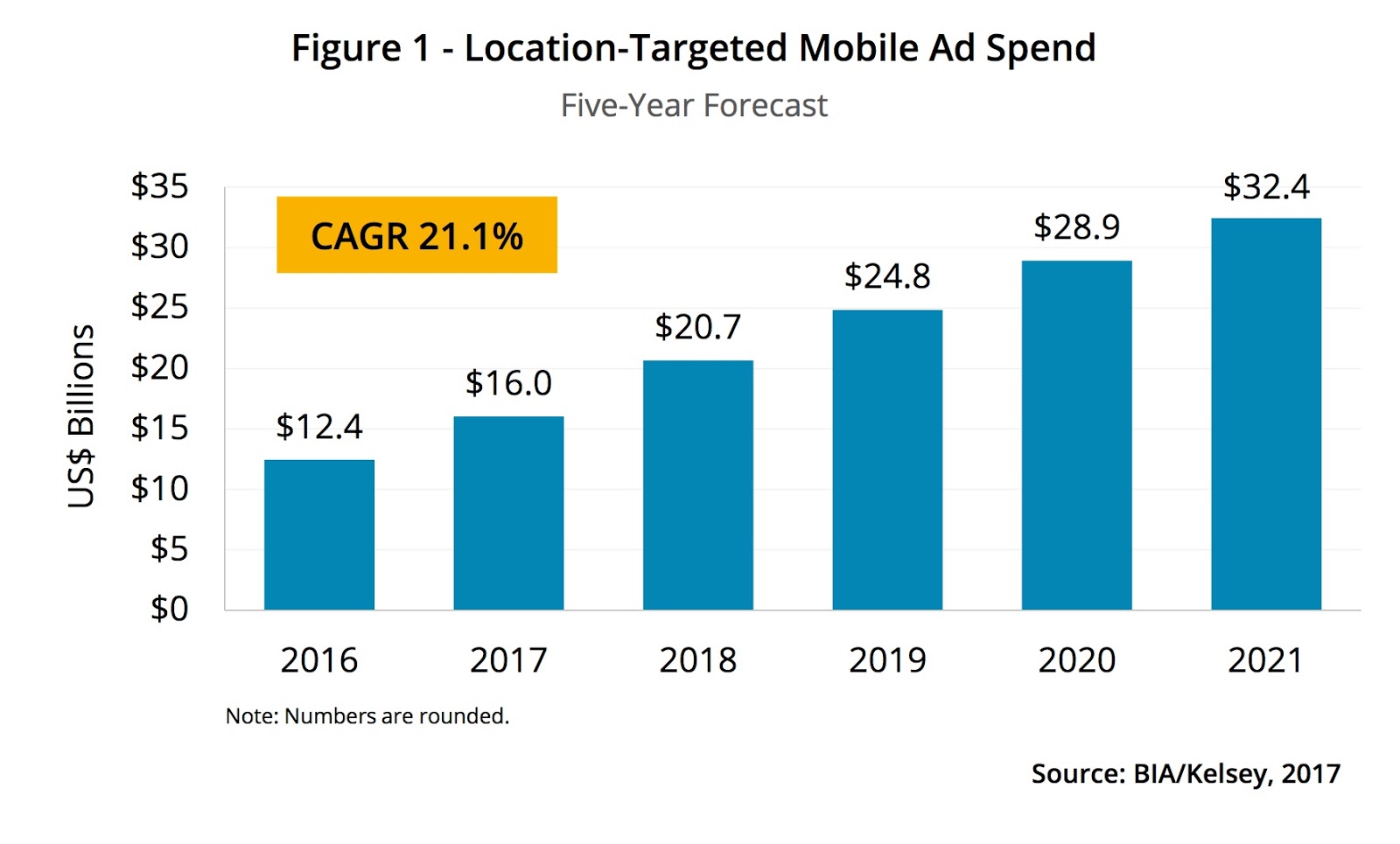
For the first time ever, market research and analyst firm BIA/Kelsey has compiled a five year forecast with in depth analysis and ad spending projections for mobile.

Why? Because mobile is the fastest growing among all location targeted media that they track.

They project mobile’s overall US ad spend in 2020 to reach $72 billion, up from $33 billion in 2016 - a 17 percent compound annual growth rate (CAGR).

Zeroing in on the location targeted portion of that overall mobile ad spend, it will grow from $12 billion in 2016 to $32 billion in 2021, a 21 percent CAGR.


What are location targeted ads? They are ads that are targeted based on a user’s location or include proximity-relevant content to trigger local offline conversions.

There are several factors driving this growth, including the mobile culture.

79 percent of mobile phones in the US are smartphones whose users spend a growing amount of time gaming, messaging and surfing social media.

Localized mobile ad spending includes in-market small businesses as well as national brand advertisers.

National brands account for the majority of the spending, largely due to their ability to implement newer technologies faster.

BIA/Kelsey also breaks down the ad spend by format including display, search, video, messaging and native-social advertising.


Search advertising currently holds the largest share, followed by display and native-social.

They project that search ads will continue to hold the largest share but native-social is growing the fastest.

An example of native-social is Facebook News Feed Ads which are based on past behaviour, ie: Facebook likes, and social connections to people and groups.

For companies to take advantage of the growth in mobile advertising, BIA/Kelsey emphasizes the importance of native formats when creating ads.

This means formats that are built “mobile first” or “mobile only” instead of being taken from other formats and plunked into mobile.

11 January 2017

BUSINESS - US Pet Food Market to Reach $30B by 2022

A recent report by Zion Market Research states the “US pet food market is expected to reach USD 30.01 billion in 2022 and is anticipated to grow at a CAGR of 3.36% between 2017 and 2022.”

The US pet food market had a value of US$24.60 billion in 2016.

The report, Pet Food Market (Wet Food, Dry Food, Nutrition, Snacks and Others) for Cats, Dogs and Other Animals: US Industry Perspective, Comprehensive Analysis and Forecast, 2016 – 2022, defined pet food as ready to serve food for pets such as dogs, cats, fish, birds and others.

The predicted growth of the pet food market is based on a rise in discretionary income, the increasing variety of ready to serve food on the market, and continued increase in the number of owned pets.

The National Pet Owners Survey in 2015 indicated around 60% of US houses have pets.

The shift in preference for nutritious pet food over the conventional food is also expected to foster the demand for pet food in the U.S.

The report notes there are almost 300 manufacturers operating in pet food sector in US which in total produce approximately 7 million tons of pet food annually.

Some of the major global players in pet food are Mars Petcare Inc., Big Heart Pet Brands, P&G PetCare, Nestle Purina PetCare, Hill’s Pet Nutrition, Diamond Pet Foods, Deuerer, Blue Buffalo, WellPet and Heristo AG.

05 January 2017

BUSINESS - Top 25 Pet Retailers

The pet market has experienced more than 20 years of consecutive sales growth and Pet Business Magazine has released its latest edition of the top businesses in that sector.

Their Top 25 Pet Retailers are ranked based on the number of outlets they operate in North America.

The story of 2016’s leaders? Expansion.

The number of stores encompassed by the Top 25 grew by more than 500 units over the past 12 months, which represents a 10 percent increase since the last edition of the list was compiled in early 2016.

Clearly expansion is an accelerating trend - the Top 25 store count only grew by five percent over the previous 10 years.

For the first time, numbers one and two on the list, PetSmart and Petco, were not responsible for adding the most stores.

Number three, Markham Ontario based Pet Valu opened the most stores with 150.

There were also a number of mergers/acquisitions in 2016 which contributed to the growth of companies.

Rounding out the top five are Pet Supplies Plus and Canadian-based Global Pet Foods.

As well as opening more stores, industry leaders like PetSmart are focusing on ecommerce and service expansion with revamped store concepts.

Bentley’s Pet Stuff, Kriser’s and Earthwise Pet Supplies are all new additions to the list this year.

See all of the Top 25 - read the entire article.


25 November 2016

BUSINESS - PetSmart Acquisition Sheds New Light on Corporate Valuation

AllPaws.com purchased by PetSmart

Richard Kestenbaum, Partner at Triangle Capital, recently wrote about the value of emerging subscriber based companies in Forbes magazine.

His startling conclusion is that many companies that once held great value are no longer given the same regard, while some of those formerly considered worthless are now regarded as having great value.

He draws this conclusion from Triangle’s participation as sell-side advisor on the AllPaws.com acquisition by PetSmart which is a recent real world event.

Furthermore, he admits that he and his colleagues were surprised by how things worked out as the transaction progressed.

PetSmart makes no money when a pet is adopted and yet the company looks upon the AllPaws transaction as core to their business:

“Pet adoption is core to our purpose-driven business, and the acquisition of AllPaws offers a smart technology platform to accelerate our in-store adoption program even further,” said Michael Massey, president and chief executive officer for PetSmart.

“Our leadership role in pet adoption has led to a record-setting seven million pets adopted from our stores since we started the in-store adoption program in 1994. More than 3,000 current animal welfare partners -- plus thousands of additional rescues and shelters -- will be able to use AllPaws as a digital hub to promote adoptable pets, which we believe will result in even greater success in finding forever homes for pets across North America.”

As Kestenbaum notes:

“Convincing consumers that a business has a purpose beyond making money and is consistent with consumers’ values is key to developing a sustainable and trusting relationship with consumers and maintaining sales and profits.Never before have values been so closely associated with earnings and success. This is new. 

"About half the population has a dog and 35% has a cat. But among Americans in their 30s, 75% have dogs and 51% have cats. Even though the pet industry is exploding, having grown threefold in the last ten years, PetSmart knows that they can’t rely on a growing industry, they have to share their customers’ values to continue succeeding.”

What does this mean for emerging companies like Urban Animal Corporation? Just three things:

  1. Investing capital to develop online services that can accumulate large pools of subscribers at a low cost of acquisition IS THE THING OF VALUE.
  2. Subscribers and successful services will be valued higher than revenue, income or free cash flow.
  3. In the next three to four years the scramble to acquire subscribers and services that add to the core values (purpose) of large brands will intensify.

The Paradigm Corporation has followed this trend in valuation since it emerged in late 2012. The ‘Paradigm Market Watch’ document is constantly updated to maintain a watching brief on comparable transactions and resources as well as market trends and analysis.

We believe the opportunity for clients like Urban Animal Corporation is to apply capital to add services and subscribers at a lower acquisition cost than these elements are valued by the market.

Large brands will then seek out meaningful relationships that add the substance and trust of Urban Animal Corporation to the brand’s purpose and core value.

About Executive Producer, Larry R. Evans:
Larry Evans is a futurist, a brand developer and a collaboration advocate. He is Principal of The Paradigm Corporation, which is headquartered at Thunder Ridge just outside Crossfield, Alberta, Canada. He is known for bringing a unique and predictive lens to paradigm shifts in a career that spans 45 years. Now from his wheelchair, he brings a grounded, tenacious view of brand value, client rights, online services and trusted relationships in the digital age. His perspective and values influence his life, business and ministry.

21 November 2016

DIGITAL - The Shift to Mobile Commerce

E-Commerce, which encompasses all of the commerce that happens over electronic systems such as the internet, has already changed the consumer landscape.

Consumers demand fast, responsive, accessible marketing and information and brands are adapting to meet these demands.

Now e-commerce is expanding more fully into m-commerce, as consumers move more fully into mobile-immersed lives.

People are purchasing more of their goods and services online, and using e- and m-commerce in ways that continue to integrate the digital and physical worlds.

The Internet of Things is a big part of the shift in mobile commerce.

Products such as the successful Starbucks app allow people to place orders before they arrive in the store, and exemplify how the world of connected devices is changing consumer habits.

Starbucks has also led the way in providing a seamless mobile purchase environment within the app, and has connected the app to a revamped rewards system that offers incentives to the consumer to use the app for their purchases.

Marketers and retailers should keep this in mind as they develop their own mobile apps and strategies.

Other services that offer integrated online and physical retail moments, such as same-day shipping, curbside pickup, and online reservations for restaurants and hotels continue to expand the mobile commerce market.

And store locators, location-based advertising and recommendations, and store associate chat options help digital customers find their way to physical retail locations.

Since offline sales still account for more than 90% of retail purchases, getting customers into physical stores is still an important part of marketing strategies.

Android Pay, Apple Pay, and Samsung Pay are all other examples of the intersection of the Internet of Things and e- and m-commerce.

MasterCard has introduced the Commerce for Every Device program, which hopes to provide payment capabilities for a range of connected devices, offering convenience with the promise of security.

Even without looking at connected payment options for wearables and other internet-connected devices, people are already taking advantage of the larger screens and personal accessibility of smartphones for their purchases.

Payment options are more smooth and frictionless, and the unreliability of mobile shopping carts that plagued retailers as recently as 2014 have mostly been smoothed out.

With new mobile payment options being rolled out in quick succession, including North American and European companies like Ericsson following Africa’s lead when it comes to mobile commerce, smartphones are positioned to maintain their dominance.

One mobile commerce service that has tried to find traction and consistently failed is the buy button on social media sites.

Consumers are not yet ready to move their consumption onto social media sites, and they tend to go directly to retailers.

However, once levels of trust in the security of social media sites rises, it’s possible that buy buttons will seamlessly integrate customer purchases into their social media experience.

On the other hand, conversational commerce is growing and will continue to grow.

Chatbots, virtual assistants, and the aforementioned sales associate web chat services are an important part of the new e- and m-commerce.

Bots and virtual assistants are not yet providing the rich and interactive experience that consumers want, but they are in the early stages of technological development.

By Tiffany Sostar
Tiffany is a writer, editor, academic, and animal lover who came late to her appreciation of pets. At 18, a rescue pup named Tasha saved her from a depression and she hasn't looked back. She has worked as the canine behaviour program coordinator for the Calgary Humane Society, and was a dog trainer specializing in working with fearful and reactive dogs for many years. She doesn't have any pets right now, but makes up for it by giving her petsitting clients (and any dogs she comes across on her frequent coffee shop adventures) extra snuggles.


31 October 2016

BUSINESS - What is Modern Marketing?

The modern approach to marketing has shifted to being customer-centric, building personalized connections, adapting to the evolution of technology, attracting customers  using inbound marketing, and more.

It seems the digital world has impacted marketing in a big way and businesses can use some help to find this new path.

Olive & Co. has developed a useful infographic called the 8 Pillars of Modern Marketing.

They describe modern marketing as a holistic, adaptive methodology that connects brands with real customers and drives business results by blending strategy, creative, technology and analysis.

Developing plans and strategies for marketing today is the most challenging it has ever been.

There is an incredible and increasing choice of interactive devices, platforms and channels that potential customers use from smartphones and tablets to social networks and search engines.

This infographic can provide some guidance for companies creating a marketing strategy.

Want more details? The company also offers a free ebook - The Definitive Guide to Modern Marketing.


24 October 2016

BUSINESS - Psychometric Testing Takes a Step Forward with Emergenetics Profile

The field of psychometric assessment has grown significantly in the last few years.

According to a 2014 CEB report, the frequency of psychometric testing as part of the interview process grew to 62% in 2014, and the trend makes sense for employers.

There are significant benefits to personality screening in the interview process, because it can help find the right person for the job and prevent expensive and frustratingly preventable staff turnover.

These benefits are primarily for the employer, but there are also benefits for the employee.

Psychometric assessments can help mitigate the biases that every interviewer brings to the table, and can give employees who may not interview well a better chance of being seen for the other skills they may have to offer.

For other employees, such as individuals with dyslexia, psychometric tests can be a significant barrier and workplace accommodations are necessary to prevent discrimination.

A quick google search turns up page upon page of advice to prospective employees about how to “pass” psychometric assessments.

Employee fears of being deemed a “bad fit” or having the “wrong” personality are overwhelming, and it is true that many tests fail to get at the fundamental personality of the applicant and instead test knowledge – which can be acquired and doesn’t indicate a person’s fit within an organization.

Emergenetics is a “people solutions company” that offers a more holistic profile, encompassing not only thinking attributes such as a candidate’s tendency towards analytical, structural, conceptual or social thought, but also behavioural attributes such as flexibility, assertiveness, and expressiveness.

By bringing a multifaceted focus to the assessment, Emergenetics hopes to avoid the pitfalls of other tests and offer something that is less “pass/fail” and more informative.

They want to provide a way to help teams work together more effectively, and provide individuals with insight into how they can adapt to new situations and engage with coworkers and customers in ways that are productive and take advantage of each other’s strengths, rather than stumbling over points of friction or differences in thinking style or temperament.

A significant benefit of the Emergenetics assessment over other available assessments is that the “norm” against which test takers are measured is updated every two years. This is in keeping with Emergenetics International’s commitment to brain research.

In a social climate that is undergoing significant and rapid change, knowing that your assessment will account for changing gender norms and preferences is critical. Every test includes bias, and updating the norms every two years helps mitigate these biases.

Psychometric assessments work best as a process, rather than a one-time event.

This is another area where Emergenetics excels, through their app and their Meeting of the Minds workshops. However, it is up to the organization and the individual to access these resources.

Similar resources exist for other personality assessments, such as the well-known Myers-Briggs or the Hogan Assessment, but these resources are only as good as the people who access them.

What Emergenetics offers is a step forward for assessment science, and a more holistic view of individual employees and team dynamics.

Emergenetics Canada has offices in Toronto (905-636-0797), Vancouver (604-992-0261), and Calgary (403-226-0878), and associates across the country. You can also reach them by emailing connect@emergeneticscanada.com.

By Tiffany Sostar
Tiffany is a writer, editor, academic, and animal lover who came late to her appreciation of pets. At 18, a rescue pup named Tasha saved her from a depression and she hasn't looked back. She has worked as the canine behaviour program coordinator for the Calgary Humane Society, and was a dog trainer specializing in working with fearful and reactive dogs for many years. She doesn't have any pets right now, but makes up for it by giving her petsitting clients (and any dogs she comes across on her frequent coffee shop adventures) extra snuggles.