Showing posts with label mobile advertising. Show all posts

27 January 2017

FUTURE TRENDS - Mobile ad Spending Projected to Reach $72 Billion by 2020

For the first time ever, market research and analyst firm BIA/Kelsey has compiled a five year forecast with in depth analysis and ad spending projections for mobile.

Why? Because mobile is the fastest growing among all location targeted media that they track.

They project mobile’s overall US ad spend in 2020 to reach $72 billion, up from $33 billion in 2016 - a 17 percent compound annual growth rate (CAGR).

Zeroing in on the location targeted portion of that overall mobile ad spend, it will grow from $12 billion in 2016 to $32 billion in 2021, a 21 percent CAGR.
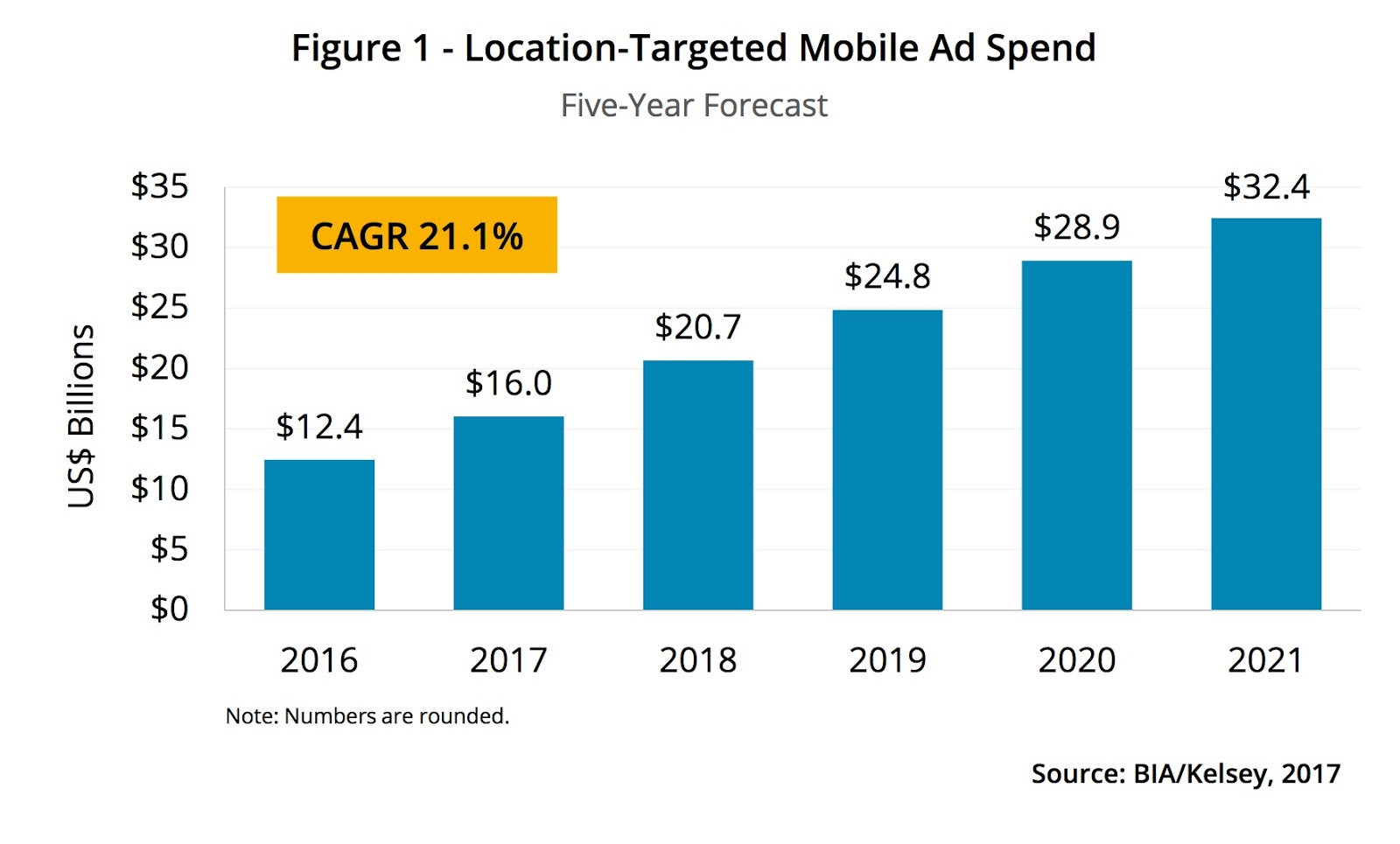


What are location targeted ads? They are ads that are targeted based on a user’s location or include proximity-relevant content to trigger local offline conversions.

There are several factors driving this growth, including the mobile culture.

79 percent of mobile phones in the US are smartphones whose users spend a growing amount of time gaming, messaging and surfing social media.

Localized mobile ad spending includes in-market small businesses as well as national brand advertisers.

National brands account for the majority of the spending, largely due to their ability to implement newer technologies faster.

BIA/Kelsey also breaks down the ad spend by format including display, search, video, messaging and native-social advertising.


Search advertising currently holds the largest share, followed by display and native-social.

They project that search ads will continue to hold the largest share but native-social is growing the fastest.

An example of native-social is Facebook News Feed Ads which are based on past behaviour, ie: Facebook likes, and social connections to people and groups.

For companies to take advantage of the growth in mobile advertising, BIA/Kelsey emphasizes the importance of native formats when creating ads.

This means formats that are built “mobile first” or “mobile only” instead of being taken from other formats and plunked into mobile.

22 September 2016

Digital Ad Spending to Exceed TV This Year

eMarketer recently reported that U.S. digital ad spending will surpass TV ad spending by the end of 2016 for the first time - one year earlier than they had originally predicted.

Advertisers have been rushing to purchase digital at the expense of traditional advertising like print, and the shift has been happening more quickly than anticipated.

According to eMarketer, by the end of this year, US digital ad spending will reach $72.09 billion, while TV spending will grow to $71.29 billion.

That means digital will represent 36.8% of US total media ad spending, while TV will have 36.4%.

They are quick to point out that TV ad spending is still growing, particularly in light of the Olympic Games and U.S. federal election this year.

Mobile ad spending will grow 45.0% this year to reach $45.95 billion and as it grows, it will represent an increased share of overall ad spending.

Google has cornered the market on mobile advertising with a 32% share.

eMarketer predicts video ad spending will reach $10.30 billion, representing 14.3% of total digital spending this year and the figure will climb to 15.1% next year.

Display ads, where Facebook leads the market at almost $12 billion in 2016, will continue to be the dominant form of digital advertising for several years to come.

27 January 2013

Deloitte's Technology, Media and Telecom (TMT) Predictions


Here are 35 slides every Canadian executive should view! 

Which are the top predictions related to the companion animal industry? They could be understanding BYOC (InfoStream calls it Untethered), Crowd funding and mobile advertising. 


Deloitte's top 10 Canadian predictions for TMT in 2013
  1. Over 90% of user-generated passwords will be vulnerable in seconds – what authentication practices could your organization adopt?
  2. More than 99% of North American TV subscribers will continue to subscribe – what group of customers should pay TV operators focus on and how?
  3. Two of the top three over-the-top (OTT) TV program and movie services are likely to be provided by existing broadcasters or distributors – what steps could pay TV companies take to improve perceptions of value for their service?
  4. TV screens with 4 times the resolution of HD will hit the Canadian market by year-end– will the significant capital expenditure that is required translate into success?
  5. The traditional PC will continue to be the primary device for work and play – how can this trend prove accurate while the proportion of traffic from other devices is growing?
  6. Despite some real risks, crowdfunding portals will raise $3 billion in the year ahead – what are the key risks your company should be aware of?
  7. Seeing mobile advertising as two distinct categories - tablets and smartphones - will be the only way for businesses to unleash innovation in each – what kinds of opportunities in second screening do smartphones and tablets offer?
  8. Over 90% of Fortune 500 companies will have an Enterprise Social Network (ESN) – what is critical in building an ESN your employees will actually use?
  9. Over 50% of Fortune 500 companies will allow employees to bring their own computer at work – how can the voluntary “Bring Your Own Computer” policy become a key tool in the organization?
  10. Wireless spectrum exhaustion will lead to more congestion for users – what can regulators and carriers do to alleviate this issue?