Showing posts with label advertising trends. Show all posts

27 January 2017

FUTURE TRENDS - Mobile ad Spending Projected to Reach $72 Billion by 2020

For the first time ever, market research and analyst firm BIA/Kelsey has compiled a five year forecast with in depth analysis and ad spending projections for mobile.

Why? Because mobile is the fastest growing among all location targeted media that they track.

They project mobile’s overall US ad spend in 2020 to reach $72 billion, up from $33 billion in 2016 - a 17 percent compound annual growth rate (CAGR).

Zeroing in on the location targeted portion of that overall mobile ad spend, it will grow from $12 billion in 2016 to $32 billion in 2021, a 21 percent CAGR.
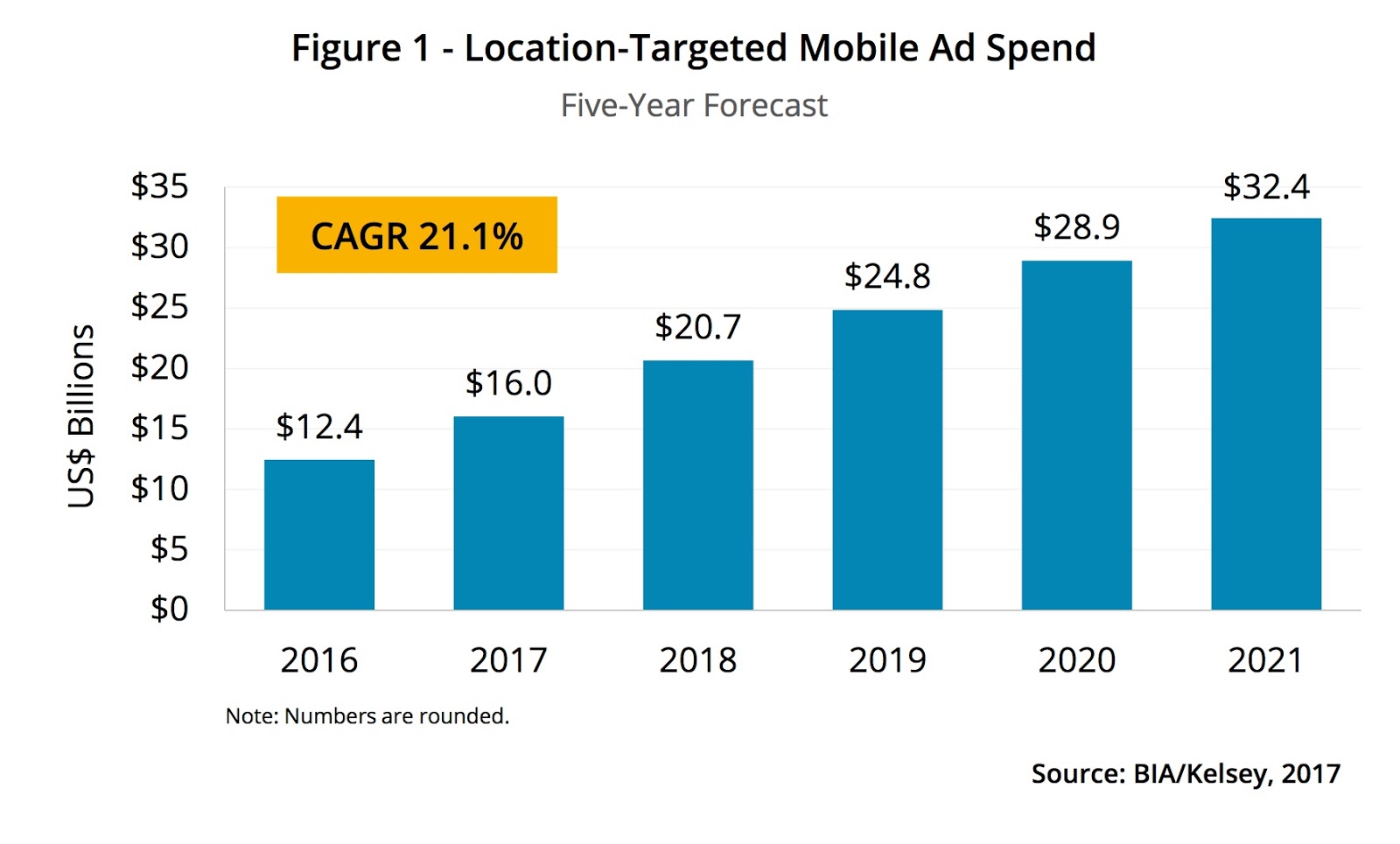


What are location targeted ads? They are ads that are targeted based on a user’s location or include proximity-relevant content to trigger local offline conversions.

There are several factors driving this growth, including the mobile culture.

79 percent of mobile phones in the US are smartphones whose users spend a growing amount of time gaming, messaging and surfing social media.

Localized mobile ad spending includes in-market small businesses as well as national brand advertisers.

National brands account for the majority of the spending, largely due to their ability to implement newer technologies faster.

BIA/Kelsey also breaks down the ad spend by format including display, search, video, messaging and native-social advertising.


Search advertising currently holds the largest share, followed by display and native-social.

They project that search ads will continue to hold the largest share but native-social is growing the fastest.

An example of native-social is Facebook News Feed Ads which are based on past behaviour, ie: Facebook likes, and social connections to people and groups.

For companies to take advantage of the growth in mobile advertising, BIA/Kelsey emphasizes the importance of native formats when creating ads.

This means formats that are built “mobile first” or “mobile only” instead of being taken from other formats and plunked into mobile.

21 December 2016

BUSINESS - Are Retailers Abandoning Newspaper Advertising?

When you pick up a newspaper this holiday season does it feel a bit thinner?

That is because US retailers have reduced spending on print newspaper advertising, according to data from Kantar Media.

The reduction is in response not only to declining newspaper circulation but to changing behaviours of consumers, who are doing more of their holiday shopping online.

Kantar data shows a decline in spending of 13% compared to the same period (Nov. 21 through Dec. 11) a year ago.

However, if newspapers are removed from the data, overall retail ad spending only fell by 3%.


“Newspapers have been a challenged medium with declining circulation and revenue,” Jon Swallen, Kantar Media’s chief research officer told eMarketer.

The shift away from newspaper ads has grown as retailers focus on mobile and the development of proprietary shopping apps.

Retailers are also increasingly using social media channels in order to form stronger, more direct bonds with consumers.

The drop on advertising spending wasn't just during the early Christmas season. Retailers also spent less around Black Friday and Cyber Monday.


22 October 2016

DIGITAL - Instagram Advertising is Growing, Take Advantage

Engagement with brands on Instagram is 10 times higher than Facebook, 54 times higher than Pinterest, and 84 times higher than Twitter.

So it’s not surprising Instagram is becoming a key player in online advertising.

To help companies create effective ads, AdRoll has created The Performance Advertiser’s Guide to Instagram.

The free download includes:
  • Guidelines for Instagram ad formats
  • 17 Essential tips for Instagram advertising success
  • How to track the performance of your campaigns
  • How other companies have used Instagram to grow their business.

Social Media Examiner’s podcast - Instagram Ads: What Marketers Need to Know - goes into detail about Instagram ad features and tips.

Guest Jenn Herman, a social media consultant and Instagram expert, also discusses the differences between Facebook and Instagram ads and how to run successful ad campaigns.

Instagram is a great medium to target Millennials - with over 90 percent of users younger than 35 years old.

The social media channel has shown massive growth over the past years - from 30 million users when it was purchased by Facebook in 2012, to over 500 million users today.

Instagram’s global mobile ad revenue is predicted to reach $2.81 billion in 2017.

22 September 2016

Digital Ad Spending to Exceed TV This Year

eMarketer recently reported that U.S. digital ad spending will surpass TV ad spending by the end of 2016 for the first time - one year earlier than they had originally predicted.

Advertisers have been rushing to purchase digital at the expense of traditional advertising like print, and the shift has been happening more quickly than anticipated.

According to eMarketer, by the end of this year, US digital ad spending will reach $72.09 billion, while TV spending will grow to $71.29 billion.

That means digital will represent 36.8% of US total media ad spending, while TV will have 36.4%.

They are quick to point out that TV ad spending is still growing, particularly in light of the Olympic Games and U.S. federal election this year.

Mobile ad spending will grow 45.0% this year to reach $45.95 billion and as it grows, it will represent an increased share of overall ad spending.

Google has cornered the market on mobile advertising with a 32% share.

eMarketer predicts video ad spending will reach $10.30 billion, representing 14.3% of total digital spending this year and the figure will climb to 15.1% next year.

Display ads, where Facebook leads the market at almost $12 billion in 2016, will continue to be the dominant form of digital advertising for several years to come.

16 July 2016

DIGITAL - The Power of Pet Influencers

Move over Kim Kardashian.

There are a few new players attracting attention on the beast that is social media.

And THESE kittens (and canines) are keeping their clothes on.

They are so-called pet influencers – cats and dogs who, in some cases, make thousands of dollars posing in glamorous photo shoots and doing product endorsements, while garnering throngs of followers on everything from Twitter to Instagram and Facebook.

With last year's pet spending in the U.S. surpassing the $60 billion mark (according to the American Pet Products Association) it makes perfect sense retailers would want to reel in four-legged ambassadors to push their products.

“People have this innate perception pets generate these warm, happy, fuzzy feelings,” Loni Edwards told Digiday.

“Brands are starting to reach out because they make people genuinely happy and they want their ads to make people happy.”

(Chloe the mini Frenchie)
Edwards would know. She is a self-proclaimed “momager” to Chloe, a mini Frenchie, who is hot in the world of online pet influencers brands seek to recruit for advertising campaigns.

Her media-darling doggie has 135,000 followers, has been featured in a Budweiser Super Bowl promotion and collaborated with brands like Vogue, Martha Stewart, Barneys, Bow & Drape and PetSmart.

So popular, the pooch has even attracted recognition from her many fans.

“That was the point at which I realized she was famous,” Edwards says of a New York City moment when a stranger recognizing her canine companion rushed in excitedly for a photo.

But Chloe has by no means cornered the market.

The pet influencers realm is a dog-eat-dog world pitting several pets - which happen to be particularly cute - vying for Internet popularity.

Toast the King Charles, Nala the cat, Loki the Wolf Dog and Sir Charles Barkley are downright divas – appearing in photo shoots which pull in between $2,000 to $3,500 per endorsement deal.

Given the top dogs, so to speak, on the Instagram social media platform boast more than a million followers apiece – it pretty much goes without saying it offers a sort of exposure which translates into an ideal marketing tool for companies looking to cash in.

Industry insiders say, advertisers working with pet influencers are barking up the right tree when employing the animals to try to ramp up their advertising appeal.

Loki the Wolf Dog, a prime example of how it works, starred in a Mercedes Benz's virtual reality campaign for its 2017 GLS SUV.

“Loki and his story aligned particularly well with our SUV portfolio,” says Mark Aikman, general manager of marketing services for Mercedes-Benz USA.

“Our research has shown that a large number of SUV owners have pets.”

The top 5 animal influencers according to digiday are; Nala-cat, Marutaro, tunameltsmyheart, marniethedog and jiffpom – bona fide celebrities posing with pop stars, taking in movie premieres, promoting pet charity events and even making appearances at Black Lives Matter rallies.

“You’re essentially merging the two biggest trends — social and pet memes — and tying that with branding,” Speakr founder and CEO Marco Hansell is quoted as saying in digiday. “It’s the perfect formula.”
 
Pet influencers show no sign of waning but instead gaining popularity.

There are now management agencies that exclusively handle pet influencers.

Speakr, (which “fuels the most impactful campaigns in social for the world’s largest brands” and sees “more than 60 major brands leverage our technology platform and influencers network,”) saw a 200 percent growth from 2014 to 2015 in pet requests.

By Nadia Moharib
Nadia Moharib is an animal lover who has adopted everything from birds to hamsters, salamanders, rabbits, fish and felines. She has written about all-things-pets for years and was a long-time editor of a pet magazine in a daily newspaper which featured a Q & A column, Ask Whit, penned by her pooch (ghost written, of course.) The serial dog owner lives in Calgary, Alberta and most days can be found at a dog park picking up after her rescue pooch, Scoots.

09 July 2016

DIGITAL - Complete Guide to Instagram Advertising

Instagram is fast becoming a top platform for advertising with users two and half times more likely to click on ads than other social media channels.

As of last week, monthly active users jumped up to 500 million with 300 million active every day.

With this massive potential audience in mind, businesses are looking for ways to create meaningful, quality experiences through Instagram's ad solutions.

To help businesses succeed, HubSpot teamed up with Iconosquare to bring you The Essential Guide to Instagram Advertising.

The guide includes:
  • Integrating Instagram ads into your current advertising strategy
  • Setting clear campaign objectives focused on improving your business
  • Creating an optimized Instagram ad with our step by step guide
  • Monitoring performance metrics and moderating engagement with your Ads
  • Insights and takeaways from exclusive experimentation
  • Bonus: Cheat sheet “The Perfect Instagram Ad.”

Start your Instagram advertising campaign - Download your free ebook.