Showing posts with label Amazon Go. Show all posts

23 February 2018

MARKET - A Weekly Review of Amazon Stories and Notes

Investors Buy Into Amazon While Grocery and Pharmacy Dash For Cover 


chefs-in-kitchenRecode reports Amazon Go plans to open as many as six more cashierless Amazon Go stores this year. Watch for openings in Seattle where Amazon Go was launched and in Los Angeles where Amazon's first experiment with Whole Foods grocery delivery took place.

Everyone wonders how Walmart will respond to the Amazon Go challenge. In December Recode reported Walmart was experimenting with a new store model called Code Eight and preparing a new cashierless experience called Project Kepler that aims to reimagine in-store shopping with the help of technologies like computer vision.

Earlier this week Quartz reported that Amazon was wreaking havoc on grocery. They suggest this disruption is largely responsible for America’s largest grocery chain Albertsons bid to acquire Rite Aid. This latest move by Albertsons, which also bought meal-kit startup Plated for an undisclosed sum in September, and partnered with grocery-delivery service Instacart in late November, will give Albertsons 4,900 locations across most of the US, and total revenue of nearly US$83B. As everyone can see grocers and pharmacies are scrambling for cover. 
Will Amazon Rule the World? 
Hard to tell at this point, but it is clear the disruption afforded by Jeff Bezos' master plan is significant. Amazon wants to deliver everything you want to your doorstep, anywhere in the world. A Wall Street Journal (WSJ) video shows the e-commerce giant faces several challenges in its pursuit of a global empire. WSJ analyst Karan Deep Singh breaks down the basics with the help of an Amazon delivery box:


How are investors responding?
When Amazon.com announced fourth quarter sales were up 38% to US$60.5B earlier this month investors began to drive up the share price. The Walmart Q4 stumble reported earlier this week has increased the 'hurt' for Walmart and drove Amazon shares even higher. The Amazon Investor Page graphically shows the response.


23 January 2018

EDITORIAL - Amazon Go Challenges Others to Adapt, Adopt and Change

One Hundred Years of Retailing - Can We Deliver a More Satisfying  Customer Experience 


Image result for image of general store
General Store 1917 -  Harris and Ewing
"Hello Mrs. Smith, what can we help you with today," asks the proprietor of this modern, well stocked, general store of 1917. 

We can see most items organized neatly behind the counter, we can imagine a picker pole for reaching the high shelves and see the crates of things customers could select on the floor. 

In fact, some of us can still remember general stores in the small rural communities where we grew up. What I remember most is staff who were happy to see me, knew my name, focused on my need and were always ready to provide friendly advice - not just pushing myriad items through scanners while the clock ticks off the minutes left in their shift. 

Over the past hundred years, we have watched as retailers developed efficient operations and high volume discounting, while subject matter expertise dwindled and valuable personal interactions with customers left the scene.

The launch of the first Amazon Go store in Seattle, may deliver a new client experience that returns high value exchanges to the retail environment and delivers regular loyal patrons. Customers can purchase all the things they want effortlessly, in a process called 'Just Walk Out Shopping'. While technology takes care of the customer need automatically, Amazon's in store associates can focus on providing the experience customers desire.

Observers suggest that Amazon's win in retail has been associated with four things:
  • Discoverability (find what you want, when you want it);
  • Good prices (inventory turns); 
  • Fast delivery (automated order processing, robotics and infrastructure); and the big one,
  • Customer satisfaction (customer feedback with quick response).
The frequently asked questions on the Amazon Go web page provided  answers to questions we've heard:

Do you have any people working in the store?
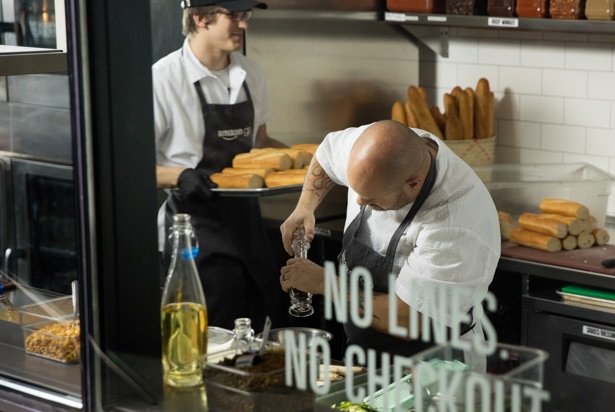
Yes. Our great team of associates works in both the kitchen and the store to prep ingredients, make our ready-to-eat food, stock shelves, and help customers. (Need a product recommendation? Ask an associate!)

chefs-in-kitchen
Amazon Go Staff Prepping Ready to Eat
How does Amazon Go work?
Our checkout-free shopping experience is made possible by the same types of technologies used in self-driving cars: computer vision, sensor fusion, and deep learning. Our Just Walk Out Technology automatically detects when products are taken from or returned to the shelves and keeps track of them in a virtual cart. When you’re done shopping, you can just leave the store. Shortly after, we’ll send you a receipt and charge your Amazon account.

What can I buy at Amazon Go?
We offer delicious ready-to-eat breakfast, lunch, dinner, and snack options made by our chefs and favorite local kitchens and bakeries. Our selection of grocery essentials ranges from staples like bread and milk to artisan cheeses and locally made chocolates. For a quick home-cooked dinner, pick up one of our chef-designed Amazon Meal Kits, with all the ingredients you need to make a meal for two in about 30 minutes.

How do I shop at Amazon Go?
All you need is an Amazon account, the free Amazon Go app, and a recent-generation iPhone or Android phone. You can find the Amazon Go app on the Apple App Store, Google Play, and Amazon Appstore. When you arrive, use the app to enter the store, then feel free to put your phone away—you don’t need it to shop. Then just browse and shop like you would at any other store. Once you’re done shopping, you’re on your way! No lines, no checkout.

How big is the store?
Our roughly 1,800 square feet of retail space is conveniently compact so busy customers can get in and out fast.

Why did you build Amazon Go?
We asked ourselves: what if we could create a shopping experience with no lines and no checkout? Could we push the boundaries of computer vision and machine learning to create a store where customers could simply take what they want and go? Our answer to those questions is Amazon Go and Just Walk Out Shopping.

The Amazon Go Experience 


It seems like the Amazon Go launch in Seattle this week has thrown down the gauntlet to other retailers. If they accept the challenge to Adapt, Adopt and Change, what response can be expected?

An article by Michelle Evans, a Retail and Technology analyst at Euromonitor, provides an overview of her discoveries at a recent gathering of retailers. She discovered neat tactics, strategies and technologies are coming to encourage a more satisfying customer experience in other retail settings. 


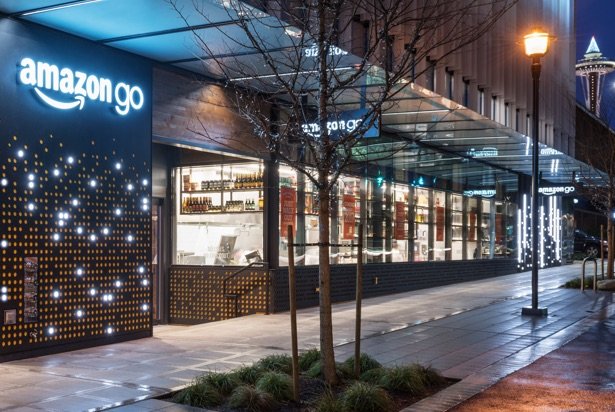
store-exterior
Amazon Go Location in Seattle

20 December 2016

FUTURE TRENDS - Amazon Opens No Check-outs, No Lines Grocery Store

Amazon has consistently lead the industry when it comes to online retailing, recognizing existing demand and creating new opportunities for e-commerce.

As Keary Crawford pointed out in Wired magazine, Amazon uses new technology – such as drone delivery – to add value and flash, but it’s the adaptive, responsive business model that is truly innovative.

(Amazon)
The same is true with the company’s new Amazon Go grocery store.

Amazon Go is a brick-and-mortar location, significantly smaller than the average grocery store at only 1,800 square feet, with grocery items such as meal kits, produce, and other staples.

The major innovation? No check-outs, no lines, no cashier. Shoppers download an app, and, using their new “Just Walk Out” technology, the cost of their purchases is added to their Amazon account automatically.

The fact that Amazon keeps its innovations in-house means that they can control the final product in a way that wouldn’t be possible if they tried to partner with another company to roll out cashier-less grocery or convenience stores.

The new Amazon Go stores are another step in Amazon’s efforts to break into the grocery market.

They have already seen success with Amazon Fresh, but the grocery market is hard to break into. Consumers like innovation, but they also have expectations about the grocery shopping experience and have shown a reluctance to embrace innovative grocery models so far.

There are risks inherent in this innovation.

Interest in the innovation is high, and according to research by Morning Consult, 67% percent of adults would be interested in the stores because of the lack of line-ups, and 59% would be interested because they wouldn’t have to use cash or a credit/debit card.

But 52% of adults would be turned off the idea because of the potential loss of cashier jobs.

Economic anxieties, and especially the issue of blue collar job loss, is a huge topic in the American political scene right now, and the timing of Amazon Go’s release might not be ideal.

However, as Hannah White writes at IoT For All, “Automation, big data, and digital systems are all here to stay. The question is, how do we implement these things as a force for good and counteract the economic divide we create?”

Amazon is not known for its focus on employee well-being, and that’s not a great sign for people hoping the company will find other placements for people who might otherwise have been hired as cashiers.

However, it’s possible that the market will open new avenues for work even as it closes more of these automatable positions.

And it’s also possible that Elon Musk, another tech innovator, is right about Universal Basic Income, and the rise of automation will not be the threat that it now appears.

Either way, Amazon Go will offer a new way to skip the line when picking up your groceries.

The store is currently in beta testing in a single location in Seattle, where Amazon employees are the only approved customers. The company hopes to launch publicly in 2017.

About Tiffany Sostar
Tiffany is a writer, editor, academic, and animal lover who came late to her appreciation of pets. At 18, a rescue pup named Tasha saved her from a depression and she hasn't looked back. She has worked as the canine behaviour program coordinator for the Calgary Humane Society, and was a dog trainer specializing in working with fearful and reactive dogs for many years. She doesn't have any pets right now, but makes up for it by giving her petsitting clients (and any dogs she comes across on her frequent coffee shop adventures) extra snuggles.