Showing posts with label Editorial. Show all posts

08 March 2018

EDITORIAL - Cryptocurrencies, Bitcoin Mining and Blockchain

What is it all about? Will it change anything? When?


Related image
Connected Securely, Transparently, Instantly, Cost Effectively
We hear cryptocurrency, bitcoin mining and blockchain in many conversations these days. The views seem to range from those who think it is hype, to those who are skeptical of the impact they face, to the very few who are convinced the world has changed forever.

At the bottom of this article is a funny video that summarizes three main flavours of sentiment toward cryptocurrency.

In this article I hope to stimulate the thinking of colleagues who may be in government, in senior management, on the advisory boards of nonprofits, directors of profit driven enterprises and those who invest. Some 2,600 are connected by LinkedIn and the rest (458K) read this blog.

Recently, the feed from CNBC ran the headline 'Secretive Chinese bitcoin mining company may have made as much money as Nvidia last year'.  The article went on to say:
  • "Based on conservative estimates of gross margin of 75 percent and operating margin of 65 percent, Bernstein analysts calculate that Beijing-based Bitmain made $3 billion to $4 billion in operating profits in 2017". 
  • "By contrast, Nvidia's operating profit was $3 billion during the same period, according to Bernstein's U.S. semiconductor team estimates".
So how can this be?  
Mostly because changes are occurring so rapidly. Of course even the casual observer will understand the implications of Nvidia Corporation profits after 24 years of capital intensive development being overshadowed by a bitcoin mining operation in its infancy. Bitmain was founded five years ago (2013) and is likely a less capital intensive operation. An interesting sidelight to this story is that Nvidia may, in fact, hold an important key to higher computing densities and lower power consumption in bitcoin mining with the SoCs and parallel processing capabilities it owns.

Okay, so what? 
Here's what. The lack of stability and massive speculation evident in cryptocurrency have blinded those who should be paying close attention to blockchain technology in the rest of the economy. 

Defining the blockchain in detail is beyond the scope of this article, however, several articles have appeared in InfoStream (Use the search feature). A recent InfoStream article featured Ginni Rometty CEO of IBM, was simple and explained blockchain to the US National Governors Association.

What is it all about? Will it change anything? When?
The main blockchain takeaways for your consideration are these:
  1. Blockchain will convert every existing value chain into an ecosystem of collaborators working to deliver products and services to the customer with full transparency, financial security, lower cost and high levels of trust.
  2. If you aren't in the ecosystem that evolves to serve your customers, you will lose your customer base and likely your business.
  3. Blockchains already exist for food safety, country of origin, manufacturing processes, funds transfer, smart contracts and financial services, to name just a few.
  4. If you move very quickly, there may still be an opportunity to be a driver of the blockchain and ecosystem that is rapidly developing to serve your customers.
  5. According to Gartner, IBM, McKinsey and other analysts blockchain will have a more powerful disruptive effect than did the Internet.
  6. In my lifetime, I have been associated with four major disruptions: Electrical to Electronic; Wired to Wireless; Analogue to Digital; and, the Bandwidth/Capacity of Optical Fibre. The speed at which blockchain is being embraced is beyond anything I have witnessed, possibly because there are so few barriers and such a high degree of benefit for all.
In my advisory activities, I use the term 'digital velocity' to define the acceleration (velocity) an organization must achieve to overcome the cultural and process inertia (gravity) preventing change and therefore future sustainability.

This is going to sound harsh, but I observe that many are ambivalent or ignorant of the consequences they face, while others sit on the deck of their  modern 'Titanic' discussing competitive improvements as the ship silently slips below the waves. My intent here is to sound an alarm and to provide a call to action.

Blessed are those who find wisdom, those who gain understanding, for she is more profitable than silver and yields better returns than gold. Wisdom, she is only a friend to those who act. It's time to get the help you need and act!


A COMMON RESPONSE TO CRYPTOCURRENCY:


23 January 2018

EDITORIAL - Amazon Go Challenges Others to Adapt, Adopt and Change

One Hundred Years of Retailing - Can We Deliver a More Satisfying  Customer Experience 


Image result for image of general store
General Store 1917 -  Harris and Ewing
"Hello Mrs. Smith, what can we help you with today," asks the proprietor of this modern, well stocked, general store of 1917. 

We can see most items organized neatly behind the counter, we can imagine a picker pole for reaching the high shelves and see the crates of things customers could select on the floor. 

In fact, some of us can still remember general stores in the small rural communities where we grew up. What I remember most is staff who were happy to see me, knew my name, focused on my need and were always ready to provide friendly advice - not just pushing myriad items through scanners while the clock ticks off the minutes left in their shift. 

Over the past hundred years, we have watched as retailers developed efficient operations and high volume discounting, while subject matter expertise dwindled and valuable personal interactions with customers left the scene.

The launch of the first Amazon Go store in Seattle, may deliver a new client experience that returns high value exchanges to the retail environment and delivers regular loyal patrons. Customers can purchase all the things they want effortlessly, in a process called 'Just Walk Out Shopping'. While technology takes care of the customer need automatically, Amazon's in store associates can focus on providing the experience customers desire.

Observers suggest that Amazon's win in retail has been associated with four things:
  • Discoverability (find what you want, when you want it);
  • Good prices (inventory turns); 
  • Fast delivery (automated order processing, robotics and infrastructure); and the big one,
  • Customer satisfaction (customer feedback with quick response).
The frequently asked questions on the Amazon Go web page provided  answers to questions we've heard:

Do you have any people working in the store?
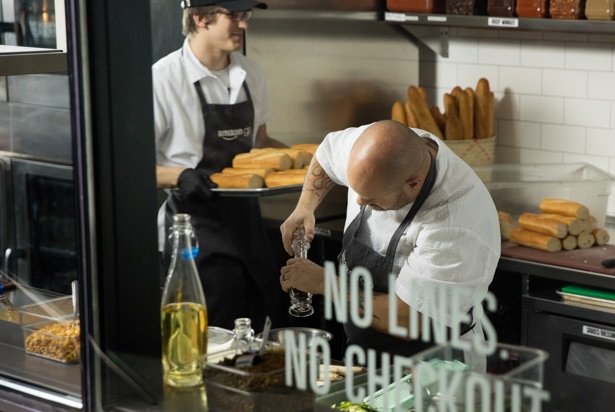
Yes. Our great team of associates works in both the kitchen and the store to prep ingredients, make our ready-to-eat food, stock shelves, and help customers. (Need a product recommendation? Ask an associate!)

chefs-in-kitchen
Amazon Go Staff Prepping Ready to Eat
How does Amazon Go work?
Our checkout-free shopping experience is made possible by the same types of technologies used in self-driving cars: computer vision, sensor fusion, and deep learning. Our Just Walk Out Technology automatically detects when products are taken from or returned to the shelves and keeps track of them in a virtual cart. When you’re done shopping, you can just leave the store. Shortly after, we’ll send you a receipt and charge your Amazon account.

What can I buy at Amazon Go?
We offer delicious ready-to-eat breakfast, lunch, dinner, and snack options made by our chefs and favorite local kitchens and bakeries. Our selection of grocery essentials ranges from staples like bread and milk to artisan cheeses and locally made chocolates. For a quick home-cooked dinner, pick up one of our chef-designed Amazon Meal Kits, with all the ingredients you need to make a meal for two in about 30 minutes.

How do I shop at Amazon Go?
All you need is an Amazon account, the free Amazon Go app, and a recent-generation iPhone or Android phone. You can find the Amazon Go app on the Apple App Store, Google Play, and Amazon Appstore. When you arrive, use the app to enter the store, then feel free to put your phone away—you don’t need it to shop. Then just browse and shop like you would at any other store. Once you’re done shopping, you’re on your way! No lines, no checkout.

How big is the store?
Our roughly 1,800 square feet of retail space is conveniently compact so busy customers can get in and out fast.

Why did you build Amazon Go?
We asked ourselves: what if we could create a shopping experience with no lines and no checkout? Could we push the boundaries of computer vision and machine learning to create a store where customers could simply take what they want and go? Our answer to those questions is Amazon Go and Just Walk Out Shopping.

The Amazon Go Experience 


It seems like the Amazon Go launch in Seattle this week has thrown down the gauntlet to other retailers. If they accept the challenge to Adapt, Adopt and Change, what response can be expected?

An article by Michelle Evans, a Retail and Technology analyst at Euromonitor, provides an overview of her discoveries at a recent gathering of retailers. She discovered neat tactics, strategies and technologies are coming to encourage a more satisfying customer experience in other retail settings. 


store-exterior
Amazon Go Location in Seattle

04 January 2018

EDITORIAL- Is Bitcoin Stable Enough to be a Currency

Image result for gold barsWould You Like to be Paid in US Dollars, Gold or Bitcoins?

Three stories that I read yesterday, gave me pause to think about cryptocurrency and in particular, to ask if Bitcoin is a currency:


We need to accept a definition of 'currency'.  

Merriam Webster defines currency as: Something (such as coins, treasury notes, and banknotes) that is in circulation as a medium of exchange; Paper money in circulation; or, A common article for bartering (Furs were once used as currency). 

Other references suggest a system of money in general use; For example the US dollar is a strong currency that may be used to settle accounts in other countries. Synonyms for currency include: Money, legal tender, cash, banknotes, bills, notes, coins and coinage.

According to Wikipedia currencies can be classified into two monetary systems: fiat money and commodity money, depending on what guarantees the value (the economy at large vs. the government's physical metal reserves). Some currencies are legal tender in certain political jurisdictions, which means they cannot be refused as payment for debt. Others are simply traded for their economic value. 

For the most part, the concept, understanding and regulation of digital cryptocurrency is still developing. However, the idea of 'common acceptance' with slow intentional movements of value or 'limited volatility' is important for a monetary system to gain and hold the trust of those who intend to use it as a medium of exchange.

On Tuesday the Wall Street Journal reported that Founders Fund, run by Peter Thiel, a PayPal co-founder and early Facebook investor, has bought millions of dollars in Bitcoin. According to some reports, the venture capital firm bought about $15 million to $20 million of Bitcoin. This news drove Bitcoin to a new high, at one point surpassing US$15,040 – a 14% daily gain. Based on the idea of 'limited volatility' this movement suggested Bitcoin is not a currency. 

However, we observed that as Bitcoin's price climbed, trading in the Chicago Board Options Exchange (CBOE) Bitcoin futures was briefly halted in accordance with pre-set rules. The Chicago Mercantile Exchange (CME) and CBOE have both launched futures contracts tied to Bitcoin's price. These new futures markets allow institutional investors to hold something that looks like Bitcoin, without having to hold the actual cryptocurrency. Some of these investors have very deep pockets and previously faced regulatory roadblocks to accessing the Bitcoin asset class. Trading in futures contracts that are settled in cash and trusting the 'halt trade' mechanism to work will add confidence to Bitcoin investors and may in the long term solve the volatility issue.

However, there are still pot holes to be avoided with Bitcoin. Jason D. Rowley, is a venture capital and technology reporter based in Chicago. On December 12th he published an article on Crunchbase suggesting Bitcoin had lost its way as a means of exchanging value. He reviewed transaction cost and other elements that were once attractive to those who used Bitcoin.

So back to the question, Is Bitcoin stable enough to be a currency? 
For most mainstream transactions the answer is likely 'no' because of the volatility and risk of value changes involved. However, Proof of Concept (POC) work to understand the cryptocurrency system and how it will have a bearing on your business in the areas of exchange, taxation, smart contracts and settlement seems advisable.

The InfoStream article on Bitcoin last year, hardly anticipated the year this cryptocurrency experienced. However, the three stories at the beginning of this article are an indication of the type of disruption that is coming toward our global monetary system.

As to the other question: Paradigm accepts settlement in US dollars, doesn't accept Gold and is experimenting (fooling around might be a better term) with cryptocurrency. Here are two other links to the Bitcoin story for your convenience:


About Executive Producer, Larry R. Evans:
Larry Evans is an experienced innovator and strategist. He is Principal of The Paradigm Corporation, which is headquartered at Thunder Ridge just outside Crossfield, Alberta, Canada. He is known for bringing a unique and predictive lens to paradigm shifts during a career that spans 45 years. Now often from his wheel chair, he brings a grounded, tenacious view of brand, ecosystems and trusted relationships for the digital age. His perspective and values influence his life, business and ministry.

21 December 2017

EDITORIAL - When Consumers Demand Proof

Ag.Com illuminates the Consumer's Need for Proof

Image result for images of groceries and food
Salvage Groceries is a Trend in Some Urban Environments

The AG.Com article by Laura Rance takes a look at trends and trust in the retail food business. It is worth the time to read. 

In this day and age of fake news and internet prevarication, trust has taken a nosedive. 

Earlier this year, InfoStream published an article entitled, 'With Growing Distrust Across Sectors, is Trust in Crisis?'Quoting studies by Edelman and Gallup, this article shows that trust has fallen in general and with brands in particular.

Is it any wonder that, as Rance suggests in her article 'the rapidly changing retail food sector (consumer) wants to know what you do on your farm'. She quotes Jay Watson, of General Mills: 
“It’s not about science, it’s about values,” he said. “Facts don’t persuade people, people persuade people.”
According to industry sources, the retail food industry in Canada is worth C$118B annually. According to John Scott, Board Chair of the Canadian Agri Policy Institute (CAPI). Eighty percent of the food sold in Canada is through five companies and so-called “food discounters” such as Walmart and NoFrills, currently sell 53 per cent of the groceries purchased in Canada. 
“Retailers are trying to make sure that whatever products are in their stores can be traced all the way back,” said Scott recently. 
As in most value chains, the connections aren't obvious to the consumer. Moreover, most traceback strategies seem more about mitigating risk for the industry than developing consumer trust. Advertising that features the primary producer is already being used by the fast food industry and by food retailers in some countries. But is this attempt to improve trust really the answer that will satisfy consumers?

The essential question is framed in these terms:
"how can the primary and secondary producers of agrifood prove to a skeptical public, they are using sustainable, consumer approved, trustworthy practices in production and how can they gain/retain the trust of those who buy food"?
Recently, we reviewed the white paper on AgriFood and Agriculture prepared for the Blockchain Research Institute by researchers at York University. It seems certain that emerging technologies like blockchain will have a role in making the production system more transparent for everyone in the value chain including the consumer. However, most of the current proof of concept (POC) activity is not targeted toward North American production. 

Furthermore, at least in Canada, the AgriFood industry continues to think and speak in 'value chain' terms when 'ecosystems' are a better/best way forward. It is telling that a literature search for consumer involvement in the agrifood system is limited to historical surveys and panels. In fact, the competitive nature of value chain thinking has created many paths from producer to consumer and further fragmented attempts to shore up trust or understand the consumer experience in real time.

The evolving understanding of 'ecosystem' is an important story for InfoStream. Where once the term 'ecosystem' was used to describe a biological system and the elements required to sustain it, the term now has a broad context when used in commerce. InfoStream understands 'ecosystem' as 'interconnected elements held together by interactions that create a community of the whole'. Ecosystems will almost always include competitors who learn to become collaborators. Ecosystems trump traditional value chains because of their primary focus on consumer satisfaction and consumer experience.

Many of the recent acquisitions (search 'Acquire') stories published by InfoStream show the purchase of emerging innovators or existing ecosystems by large retailers and service providers. Further evidence of a movement toward achieving the trust and satisfaction of the consumer.

Questions that need answers:

  • Can the Agrifood Supercluster project stimulate the development of an Agrifood ecosystem in Canada?
  • If 'people persuade people', how is agrifood going to attract and retain these influencers instead of the 'blast and cast' facts approach now present?
  • What are the elements that will drive 'proof of concept' activities to overlay agrifood with a blockchain?


About Executive Producer, Larry R. Evans:
Larry Evans is an experienced innovator and strategist. He is Principal of The Paradigm Corporation, which is headquartered at Thunder Ridge just outside Crossfield, Alberta, Canada. He is known for bringing a unique and predictive lens to paradigm shifts during a career that spans 45 years. Now often from his wheel chair, he brings a grounded, tenacious view of brand, ecosystems and trusted relationships for the digital age. His perspective and values influence his life, business and ministry.

https://www.linkedin.com/in/larryrevans


11 December 2017

EDITORIAL - Lynn David Chouinard Rests

Well Known Alberta Horseman, Investor, Farmer and Faithful Catholic enters Rest 

Lynn-CHOUINARD-Obituary
We mark the passing of our colleague Lynn Chouinard who entered into Eternal Rest last Thursday. 

Our connection with Lynn began as shareholders of PetLynx Corporation. As an 'angel investor' Lynn  supported management with capital and advice.

However, our fondest memory of Lynn was a visit Janice and I had to see the completed restoration of the St James Catholic Church and the new Grotto at Bar None Ranch. Although I had visited the ranch several times for business, it was on this occasion that we learned of Lynn's faith in God and his love of the Church. Lynn was very proud of the memorial garden and setting that he had created to honour God.

I offered to sing the Prayer of St Francis in that beautiful old church. It touched Lynn and he asked if I would also sing some of his favourite hymns. What a wonderful experience we had together. 

Here below are links and a video to give you a glimpse of Lynn's life:

Bar None Ranches

2006 Article

Obituary


Eternal rest, grant unto Lynn, O Lord,
And may your perpetual light envelope him. 
In your mercy and grace, O Lord 
May you give Lynn eternal peace,
And may you grant,
His loved ones comfort and hope,
As only you can give.
Amen.

03 December 2017

EDITORIAL - Bring Back the Sabbath?

IN A WORLD THAT IS ALWAYS ON, SHOULD WE, MUST WE, DEMAND REST

Image result for rest imagesRecently I came across an article in the New York Times By JUDITH SHULEVITZ

She writes in an earlier time (MARCH, 2003) but the story spoke to me today. It shares her journey, her wrestle with her own need for Sabbath and it challenges us to become more mindful of our need for rest. I am a person often driven by a need to create, a person that technology once enslaved and a person who often experienced endless cycles without rest.

In the Genesis story of creation, we observe a first Sabbath, God taking time to rest and consider what He had created. In an earlier time of my life, resting on Sunday was enforced by Christian parents. As an adult the Baptist lifestyle often seemed a little ritualistic and later in life I just slipped away from the disciplines of earlier life. 

However, in recent years, I have returned to Sabbath as the practice of a weekly rest and as a time when my phone, the TV, the radio, the internet and other distractions are avoided. In addition, worship of the Creator has also returned to my life and a ministry of encouragement has flourished in my relationships. There have been several impacts. I see things around me I used to miss. I suspect my wife and family see a different, more attentive person (at least one day a week). But most of all, I find myself more thankful, more accepting and more appreciative than anxious and frustrated. 

Do I still shop on Sunday? Occasionally. 
Do I still work on Sunday? Very seldom. 
Do I enjoy a Sabbath meal and fellowship with friends? More than ever. 
Do I fail to receive important phone calls, texts and emails? Yup, until Monday.
Do I regret turning things off for one day? Never.
Do I now expect a Sabbath? Always.


Image result for rest images
The past four years has brought us three grand babies. Watching them rest with such innocence and peace reassures me that Sabbath is right and rest is one of the best, most necessary practices for life. 

I can't speak for what you should do. But I will encourage you to make room for Sabbath. And I hope this rest awakens your faith in God. 

I have come to believe life is never really enjoyed without practising Sabbath. However, you are unlikely to hear this from the cacophony of voices that overwhelm us today. 

I am also convinced you will have more joy and peace in your life if you become more mindful of your need for Sabbath.


God bless!

About Executive Producer, Larry R. Evans:
Larry Evans is an experienced innovator and strategist. He is Principal of The Paradigm Corporation, which is headquartered at Thunder Ridge just outside Crossfield, Alberta, Canada. He is known for bringing a unique and predictive lens to paradigm shifts during a career that spans 45 years. Now often from his wheel chair, he brings a grounded, tenacious view of brand, ecosystems and trusted relationships for the digital age. His perspective and values influence his life, business and ministry.

https://www.linkedin.com/in/larryrevans


26 July 2016

EDITORIAL - What Yahoo can Teach us about Business

The VOX Technology article by Tim Lee yesterday provides an explanation of Verizon's purchase of Yahoo.

There's no happy little internet story here.

In fact, Yahoo, like AOL is a story of missed opportunities and failed strategies.

A company that made correct early stage investments in the very companies that would later dethrone it in 'search' and 'social'. A company that was once the biggest play on the internet brought to its knees and sold for a tiny percentage of its earlier market valuation.

Analysts suggest that Verizon will reap the benefits of adding Yahoo’s advertising engine to its 100 million subscribers, and well they might.

However, the real learning for everyone in business may be from understanding how a company with the largest base of subscribers in early internet history, a trusted ecosystem if you will, lost its way.

Personal digital devices and a ubiquitous internet (mobile network) have redefined the power structure for consumers and marketers.

Around the world consumers, who own 'demand' are being empowered to evaluate and discover brands that own the 'supply' (product/service) at the moment they desire something. We observe that movement from brand to brand is often radical and completely unrelated to the value or supply chain that was once paramount. The new environment honors the quick draw and the agility of those who command this new frontier. Remember the 'Oreo tweet' of Super Bowl 2013.
  
Expect to see more traditional brands like Unilever acquiring upstarts like Dollar Shave Club in a quest for loyal subscriber/customers.

Expect to see more brands experiment like P and G's approach to the Tide brand with the Tide Wash Club.

Expect to see subscriber-based valuations for ecosystems like LinkedIn or Wind Mobile continue to rise well beyond traditional valuations which are based on free cash flow or income.

Expect to see the 'experience factor' (length of subscriber experience) of active residual subscribers become the most important aspect of value.

The times, they are 'a changin' and it may be time to review the things we value in business.

About Executive Producer, Larry R. Evans:
Larry Evans is a futurist, a brand developer and a collaboration advocate. He is Principal of The Paradigm Corporation, which is headquartered at Thunder Ridge just outside Crossfield, Alberta, Canada. He is known for bringing a unique and predictive lens to paradigm shifts during a career that spans 45 years. Now from his wheelchair, he brings a grounded, tenacious view of brand, client rights and trusted relationships for the digital age. His perspective and values influence his life, business and ministry.


03 July 2015

EDITORIAL - The Times, They are a changing

Bob Dylan's ballad to change (1964) is relevant today


Come, gather round people wherever you roam
And admit that the waters around you have grown
And accept it that soon you'll be drenched to the bone
If your time to you is worth saving
Then you'd better start swimming or you'll sink like a stone
For the times, they are a changing


A CBC story on Thursday highlighted 1,000 layoffs at BBC and a complete refactoring of Britain's national broadcaster. This response to change bares further scrutiny.
Last month, the BBC's Head of News, James Harding, predicted that by the end of the next decade (2025) most people in the United Kingdom would receive their program content over the Internet. He also said:
"The Internet has ripped a hole in the business model of many great news organisations." 
More recently BBC, Director General, Tony Hall admitted:
"There are very tough things happening out there and the hard choice that is happening to us is that the number of households with TVs is diminishing, slowly, but it is diminishing."
'Ripped a hole in the business model', really?? 
Clients view the Internet as the best thing that has ever happened to the 'news' business. The Internet has accelerated news collection, improved distribution and eliminating cost. What the BBC and other broadcasters didn't anticipate was a need to move strategies from 'scarcity' (available only from the BBC) to one of 'abundance' (available everywhere, at anytime, from everyone) and the impact that would have on it's advertising revenue model

'The number of households with TVs is diminishing', pardon me?? 
NOW HEAR THIS  - Mr. Hall you are measuring the wrong thing. According to a recent report in Mobile Marketing, more than 72 of 100 prospective and existing BBC customers have a smartphone and that number jumped 14% in the last ten months. According to Deloitte, smart phone usage in the UK will reach 95% and become ubiquitous by 2020. Mr. Hall, everyone of these consumers can be served your product without a TV. The number of TVs is irrelevant.

One can observe the pain in 'Broadcaster Speak' coming from Harding and Hall, but as Dylan sings '..you'd better start swimming or you'll sink like a stone, for the times, they are a changing'. 

Around the globe, the major scramble to find sustainable practices in a landscape of rapidly shifting consumer behaviors features advertising agencies, content providers, broadcasters and media companies. Many of these players were the 'wise' Rulers that governed communication and contact with the consumer. Retailers and brand companies paid homage and lots of 'gold' to the reigning experts of the day. These experts charged their clients according to some magical formula based on ratings, views, impressions and eye balls. The cost of campaigns often defied forecasting logic and many had a pay back (ROI) that resembled Roulette.


Today the fears of marketing directors and brand developers is palpable. Consumers are enjoying a new world where they reign supreme. Legislators are busy shutting down direct marketing schemes in the name of consumer protection, anti-spam and privacy. 

In the evolving paradigm, consumer skepticism regarding how 'big data', 'likes' and 'pluses' are manipulating their online experience has undermined brand marketing strategies and tactics. Together these trends add volatility, uncertainty, complexity and ambiguity to an environment where enriching the consumer experience is paramount.

In this new world, one would do well to understand the client life cycle as a series of episodes. Eliminating spin and hype, while developing a reputation for authentic, transparent communication will serve clients in a continuum of trust and a relationship that extends over their lifetime. 

The times they are a changing. Anticipating change as the new norm will give service and content providers fewer surprises and many more opportunities.

About Guest Editor Larry Evans:
Larry R. Evans is a futurist, a brand developer and a collaboration advocate. He is the Principal Adviser for The Paradigm Corporation, which is headquartered at Thunder Ridge just outside Crossfield, Alberta, Canada. He is known for bringing a unique and predictive lens to paradigm shifts during a career that spans 45 years. Now from his wheel chair, he brings a grounded but tenacious view of client rights and relationships in the digital age. His perspective and values influence his life, business and ministry.