Showing posts with label service dogs. Show all posts

15 June 2016

INTERVIEW - Deb Davis, Paws With a Cause - A Leader in the Assistance Dog Industry

(LinkedIn)
Service dogs have historically been a great asset to persons living with vision impairment. In more recent years, the roles of service dogs have expanded to include assisting persons living with a range of disabilities or conditions, such as autism, asthma, seizures, brain injuries, PTSD and Lupus.
InfoStream caught up with Deb Davis, Community Outreach Manager with Paws With A Cause – a service dog training centre based out of Wayland, MI. The centre does custom training of service dogs, hearing dogs, service dogs for children with autism and seizure response dogs.
Davis shares some insights about the benefits of the relationship between service dogs and their humans, as well as some perspective on the growth of their segment of service dogs for children with autism.
InfoStream (IS): What makes working with service dogs special or unique for you?
Deb Davis (DD): What makes this work unique and special for me is our clients – people with disabilities who are able to change their life because of their assistance dog. They are some of the most amazing people I will ever know in my life, and my life has changed because of them.
IS: Your organization trains dogs to assist people in a variety of capacities, including seizure response, vision and hearing impairment and autism - could you please share with us how some of these newer areas have grown in popularity over the last few years?
DD: Training service dogs for children with autism has really caught on in the past five years. Our organization did a two-year study with an organization in Canada, prior to launching our own three-year pilot program for this discipline. At PAWS, we don't just train a dog and then hand over the leash and say 'have a nice life'. We work with the clients for 4 - 6 months, after their dog has already been trained specially for them for 4-6 months. That's a lot of time and a huge commitment on the client's part. So, when families who are living with autism reach out to apply for a dog, we feel honored to be able to provide them with another 'tool' in their autism toolbox.
Families who live with children with autism already have a lot of things to handle in their lives: the child, occupational therapy, physical therapy, speech therapy, play dates, school, etc. For them to accept a service dog into their lives is a great indication of their commitment to making their child's world one step easier.
Our Seizure Response Dog Program's popularity is another testament to our clients - people who want to live independently, yet live in constant fear that a seizure could severely hurt them or worse, kill them. We have clients who have a seizure response dog because they want to live alone, yet are fearful of suffocating in their pillow if they have a seizure during the night. That's pretty intense. Yet, they feel completely relieved of that fear by living with their seizure response dog. We have one client whose parents would not let him go off to college and live in the dorms until he could prove to them that he would work with his seizure response dog. I'm happy to say, they graduated.
IS: What does PAWS want people to know about what it is that makes an assistance dog more effective compared to human assistance options in some regards?
DD: The dog/human bond is an incredible thing to witness...for the human to be able to put their 100% trust in their dog is really a miracle before our eyes. The dog is a constant in their lives, 24 hours per day, day and night. Dogs don't have bad days, like aides do; dogs don't need batteries, like technology and machines do; medications reach a plateau of effectiveness and can change a person's behavior and reaction to stimuli; dogs don't. People who are hearing impaired/deaf who have a cochlear implant are still hearing impaired/deaf when they take off that cochlear implant; that's when they are most vulnerable. The dog is there as a constant reminder that they have someone to trust, and someone or something that is reliable and will take care of them.
(Paws With a Cause)
IS: What would you say to a parent with a child on the autism spectrum who is contemplating a service dog?
DD: After placing more than two dozen service dogs with children with autism, we've asked those parents what would they tell someone in this situation. Their overwhelming response has been "Do it!" Their fears were about having enough time to dedicate to the dog and when they realize that the dog folds into their already-established lifestyles, that fear is gone!

By Lindsay Seewalt
Lindsay is an experienced journalist and mother of three whose heart and home is always open to a four­-legged friend. With her Corgi, Angie, as household editor-­in-chief, Lindsay gives back to the animal planet through the written word on anything and all ado about pets. She is passionate about topics regarding animal welfare and responsible pet ownership, which she aims to instill in both her readers and children to be compassionate animal lovers who are conscious and considerate that furry friends around the globe deserve a voice.

11 June 2016

RESEARCH - Dogs May be Able to Detect Malaria in Humans

(medicaldetectiondogs.org.uk)
Dogs help to keep us healthy.

Beyond getting owners out for a walk, and the healing benefits of petting, dogs are a significant part of many people’s healthcare routines.

Dogs are used as service, assistance and therapy animals and there are even dogs trained to detect blood sugar levels and alert diabetic individuals of an imminent crash.

Now, dogs are also helping with another piece of the healthcare puzzle.

Following last year’s NHS approval for the use of cancer detection dogs in a medical trial, dogs’ highly sensitive noses are being turned to malaria detection.

The Bill and Melinda Gates Foundation, which has focused on malaria eradication for years, has backed new research starting later in 2016 at Durham University.

The University, with Prof. Steve Lindsay leading the project, will partner with Medical Detection Dogs, the London School of Hygiene & Tropical Medicine and the Medical Research Council Unit, the Gambia

Current malaria testing requires blood collection and lab testing, which is time intensive and costly.

If this research is fruitful, malaria dogs could detect the presence of the disease from urine and sweat samples, and could work much faster than lab testing of blood allows.

The dogs could also be used in mobile units, or at points of entry to an area, which would help increase access to testing, and treatment.

They will be sniffing for the presence of specific odours that humans produce after being infected with the malaria parasite.

Dr Claire Guest, CEO of Medical Detection Dog, an organization that specializes in training dogs for medical purposes, told The Independent, “Dogs have an extraordinary sense of smell. They can detect parts per trillion; that is equivalent to one spoon of sugar in two Olympic-sized swimming pools. In training trials, they have proven themselves to be 93 per cent reliable at detecting cancer. I feel confident they will learn to detect the odour of malaria.”

Malaria is a significant global health concern, with an estimated 214 million cases and 438,000 deaths globally in 2015.

By Tiffany Sostar
Tiffany is an animal lover who came late to her appreciation of pets. At 18, a rescue pup named Tasha saved her from a depression and she hasn't looked back. She's written for a variety of publications and facilitates writing workshops for marginalized writers. She's particularly interested in animal behaviour, and working with trauma recovery for four-legged and two-legged animals.

04 March 2016

New Laws to Address Service Animal Deception


Is it a dog with a job or simply a dupe trying to pass their pooch off as a legitimate service dog?

A disturbing proliferation of some trying to pose as people with service dogs is leaving those legitimately relying on the canines frustrated and threatening the believability of those truly needing the tool.

And, according to the Associated Press (AP,) it has prompted lawmakers in several U.S. states to look to legislation to restore the animals' credibility.

A 2010 amendment to United States law states “service animals are defined as dogs that are trained to do work or perform tasks for people with disabilities,” stating “service dogs are working animals, not pets.”

Dogs' tasks include everything from guiding the blind to alerting people who are deaf, pulling a wheelchair, protecting a person who is having a seizure, reminding people with mental illness to take medications and calming people with post-traumatic stress disorder.

The definition does not include dogs recruited to offer comfort or emotional support and certainly doesn't include a Wisconsin woman who last year tried to claim she could bring her kangaroo into McDonald's.

Cases like those and others where people falsely claim their canine is a service dog have prompted legislatures in some states to consider bills that would either establish a service-dog program or penalize people who fraudulently claim to have one, AP reports.

A task force in Maine recently reported that “well-meaning federal laws designed to protect people with disabilities have instead opened the door to fraud.”

And dishonest dog owners dole out consequences for those who legitimately need four-legged friends to navigate life – leading to encounters with sceptics and confrontations everywhere from restaurants to businesses.

Cases lacking credibility, however, are happening in part because there are no requirements for people to have papers to prove a canine cohort is indeed a service dog. That means a dude can take his dachshund to dinner, for instance, and dare anyone to dispute his claim the dog is helping him cope with a disability.

Because the Americans with Disabilities Act prohibits discrimination and there are no requirements for licensing, certification or identification of service dogs, it is not only bad form to discriminate but potentiality has legal consequences.

Business are only allowed to ask – is a dog needed because of a disability and what task are they trained to do – and answers must be taken at face value, regardless of whether the dog's service status is legitimate, or there could be charges, fines or lawsuits.

In the year ending June 30, 2014, there were 1,939 lawsuits in the U.S. for ADA violations, up 55% from the previous year – including a case where a condominium association paid a resident $300,000 for not allowing them to keep a service dog.

“People have also asserted service animal status for pigs, cats, rabbits, turkeys, llamas, snakes and turtles,” Jeanine Konopelski, spokeswoman for Canine Companions for Independence, a California-based non-profit that supplies disabled people with trained service dogs, told AP. “In many of those cases, people aren’t lying but misunderstand the difference between a service animal and an emotional support animal.”

To that end, some states are looking at launching public information campaigns or introduce state-issued cards to verify service dogs. Florida last year passed a law that makes misrepresenting a service animal a crime punishable by up to 60 days in jail.


By Nadia Moharib
Nadia Moharib is an animal lover who has adopted everything from birds to hamsters, salamanders, rabbits, fish and felines. She has written about all-things-pets for years and was a long-time editor of a pet magazine in a daily newspaper which featured a Q & A column, Ask Whit, penned by her pooch (ghost written, of course.) The serial dog owner lives in Calgary, Alberta and most days can be found at a dog park picking up after her rescue pooch, Scoots.

20 October 2015

Further Than Yesterday - The Inspirational Story of a Canadian Air Force Captain

Canadian Air Force Captain (Ret’d) Medric Cousineau won an Urban Animal Summit Award for Innovator of the Year in 2014 for his efforts with PTSD service dogs and Paws Fur Thought. Cpt. Cousineau works to educate all levels of government, landlords and business owners, pet industry staff and the general public; he has improved the working and living conditions for both dogs and their handlers. Cpt. Cousineau has also won an Inspiring Lives Award from the Mental Health Foundation of Nova Scotia.

Cpt. Cousineau received the Star of Courage after one particularly harrowing search and rescue mission. The Star of Courage recognizes acots of conspicuous courage in circumstances of great peril. Unfortunately this mission precipitated his downward spiral with PTSD. In 2014, InfoStream interviewed Cpt. Cousineau and he told the Urban Animal community about his story. 

Cpt. Cousineau is now ready to share his story with a wider audience. Further Than Yesterday: That's All That Counts is now available on Amazon! The book has been billed as “Intense and Inspirational" and allows readers to, “Follow Capt. Cousineau’s descent into hell, his rescue by a Yellow Lab named Thai, and then The Long Walk to Sanity to fund the service dog program called “Paws Fur Thought”... Read how Thai and other service dogs are changing the landscape of the battlefield of PTSD from the front lines.”


19 August 2015

Rescue Dogs and Other Dilemmas - UA Forums at Summit 2015

The 2015 Urban Animal Forums on Friday are an integral element of the tenth annual Summit for Urban Animal Strategies. Forums are intended to identify, research and recast dilemmas as opportunities to enrich the lives of people and pets in urban communities.

Leaders at Summit 2015 will be Dared to Disagree. The forums of Summit 2015 invite subject matter experts who will lead the attack on five previously identified dilemmas:


Service and Assistance Dogs (2015.A):
Anecdotal evidence suggests dogs can enrich the lives of people yet many initiatives are bogged down without an evidence base or accepted standards. Communities, airlines, school boards, penal institutions, service industries and breeders need industry help to recast this dilemma so more lives are enriched using companion animals.


Municipal Compliance and Ambassador Programs (2015.B):
Conflicts within the community arise between pet owners and other citizens who wish to use the same public areas. Across North America the rate of compliance associated with licensing and identification of pets is falling. The incidence of disruptive behaviors and aggression in dogs is rising. How can municipal bylaws ensure a safe environment for all? Can new approaches to licensing bylaws and enforcement succeed? The City of Calgary has obtained positive results using off leash 'Ambassadors'. Can the 'Calgary approach' be replicated to assist with other interventions? What kind of training is required? Can municipal budgets be redirected, reduced or eliminated? Do 'Ambassadors' enrich the lives of people and pets in urban municipalities?


Rescue dogs (Forum 2015.C):
Dogs are entering Urban Communities from around the globe and from other jurisdictions (breed specific legislation). As rescue dogs become more prevalent in the adoption environment from myriad sources, issues in the areas of health and socialization have emerged. How can health regulations be enforced? Who should be assessing dogs to ensure they contribute to a safe environment for people and animals? Is there a way to recast this dilemma as an opportunity to enrich communities or should these imports be shut down?
Compassion Fatigue (Forum 2015.D):
From volunteers to veterinarians, literature shows the Urban Animal industry is experiencing ‘care/compassion fatigue’ sometimes with deadly consequences. Does imperial evidence exist to define the magnitude of the problem and the possible solutions? Can a strategy be developed that solves this dilemma across an entire industry? Can the urban animal industry build emotional intelligence and resilience for human resources that eliminates critical interventions and removes this blight from professional careers?


Free-Roaming Cats (Forum 2015.E):
A new evidence based metric that determines feline populations in urban communities is coming forward from the 2015 Urban Animal IRED program. While cats have attracted passion and funding for at least 10 years, communities continue to battle issues associated with free roaming cats. Measuring the number and habits of free roaming felines now seems to be in reach. Are there new ways to recast a dilemma that has resisted mitigation efforts for several decades? Is everyone in the conversation that should be (public health, animal welfare, environmental)? Is it possible to have a respectful but rigorous debate that establishes a new path forward?

Open Space (Forum 2015.OS):
The Summit continues to gather subject matter experts who identify and recast dilemmas to enrich the lives of people and pets. The Open Space forum provides an opportunity for delegates to bring forward new dilemmas or initiatives that merit the attention of the Alliance for Urban Animals.

All Urban Animal Forums are facilitated using the Open Space Technology invented by Harrison Owen.


Summit delegate seats are filled by invitation and usually managed to 100 delegates for each Summit. However, for this tenth anniversary Summit a small number of additional seats have been added. If you or someone you know should contribute to these forums please contact Shannon Woodward.


If you have an invitation please register now!

26 March 2015

Partnership promises national registry for Canada’s service dogs


PRESS RELEASE
Partnership promises national registry for Canada’s service dogs


Calgary, AB - PetLynx Corporation and Medric Cousineau (Paws Fur Thought) are pleased to announce a new partnership that will benefit Canada’s service dogs and their owners.


Today, there are no national standards for training of PTSD service dogs in Canada forcing some provincial branches of the Royal Canadian Legion to put funding for these dogs on hold. Alberta/Northwest Territories Command is continuing to approve funding for PTSD service dogs provided certain guidelines are in evidence.


“Currently in Canada, there are no National Standards or National Registry for Service Dogs,” said Medric Cousineau, founder of Paws Fur Thought, an organization in Nova Scotia pairing service dogs with PTSD veterans. “The Canadian General Standards Board (CGSB) has secured funding to write standards. Once in place, these standards will be used to produce an ID card and be recorded in the PetLynx National Registry.”


PetLynx operates as a national database of pet records that now holds 10% of the cats and dogs in Canada. Everything from a physical description and digital image, to all forms of identification and medical information can be stored as part of an animal’s record. By utilizing the system, breeders, trainers, educators, service dog owners and those who provide standards will have one place to manage the information that is important to them. Cousineau has agreed to assist PetLynx to develop other services that will ensure service dogs are protected for life while their owners have peace of mind.


“By providing the HomeSafe™ national registry and lifetime record, all authorized stakeholders have an opportunity to manage episodes during the life of each service dog,” said Larry Evans, the founder and Managing Director of PetLynx. “Moreover, the PetLynx system offers Return-to-Owner (RTO) services and ‘peace of mind’ for owners who wish to eliminate the chance of a dog becoming lost or stolen.”


It is estimated that there will eventually be more than 30,000 service dogs in the homes of veterans and first responders in Canada.  


FOR MORE INFORMATION CONTACT:
Shannon Woodward, Communications
(p) 403.208.1972 (e) Shannon.woodward@petlynxmail.com


ABOUT PETLYNX:  PetLynx Corporation owns the HomeSafe™ and Urban Animal™ brands:

The HomeSafe™ brand supplies a central Registry and Return to Owner Service for companion and service animals. The HomeSafe™ registry and lifetime animal record is managed by the animal owner to provide return to owner services, medical records, care profiles and connectivity to other registered and authorized entities. The mission of the HomeSafe™ brand is lifetime protection for animals and peace of mind for people.

PetLynx also owns the Urban Animal™ brand which supports those who deliver the products and services animal owners need. The mission of the Urban Animal™ brand is to increase the positive experiences for people and animals in each community.

PetLynx brands deliver value across the Internet to pet owners and communities. PetLynx is a proven game changer that has registered 10% of the total cats and dogs as well as the active consumers who own them and is now the largest, fastest growing and most recognizable pet brand in Canada.

-30-

24 March 2015

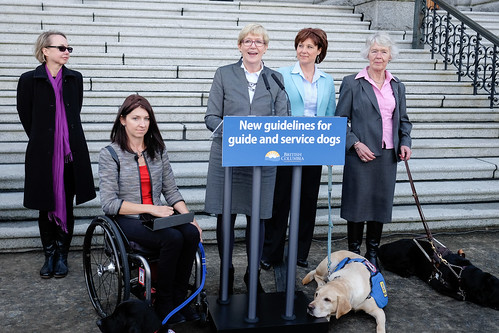
New B.C. Act introduces Guide and Service Dog standards

The need for national standards for service dogs becomes increasingly important as "fake" service dogs threaten the good works of properly trained service dogs, their owners and the organizations who train them. 

Tails are wagging for new guide and service dog guidelines
Photo Credit
Earlier this month, British Columbia introduced its new Guide Dog and Service Dog Act, which, if passed, will lay the foundation for a number of changes proposed to take effect this fall. It will establish high and consistent training standards, requiring all guide and service dogs to be trained by a facility accredited by Assistance Dogs International (ADI) or the International Guide Dog Federation (IGDF) - both of which are internationally recognized training standards. 

The Act will ensure that the public and businesses are aware that a guide or service dog is certified with new requirements around visible identification for the dogs - such as a designated tag or card for its vest. 

"These changes are about ensuring access rights for these individuals and their certified dogs and safeguarding the public through high training standards," said Attorney General and Minister of Justice Suzanne Anton. "They will also provide clarity around the rules where guide and service dogs can accompany their handlers - for the public, for business owners and staff, and for landlords and strata." 

11 November 2014

A&E makes reality show about veterans struggling with PTSD

Photo Credit: A&E
A new docuseries on A&E titled "Dogs of War" will illustrate the challenges faced by war veterans suffering from post-traumatic stress disorder as they are paired with shelter dogs trained to help them adjust to life after combat. 

This real life series chronicles the fog of PTSD that many veterans find themselves in after serving in combat, and the service dogs that bring them out of it. "Dogs of War" is the crossroads where a veteran condemned to a life of isolation, and an abandoned dog condemned to a shelter, come together to rescue one another. 

"This series is full of raw, real and intensely emotional moments that don't often get a spotlight in mainstream media," said David McKillop, General Manager and Executive Vice President of A&E. "Each veteran's story of survival is humbling and we are proud to create a series that captures the light at the end of the tunnel for these heroes." 

For more information, visit www.aetv.com 

Alliance for Urban Animals pairs service dogs with veterans

Today, Canadians pay tribute to the hundreds of thousands of men and women who serve(d) our country.
We honour the countless deaths in the name of freedom and consider the individuals who narrowly escaped death and walk among us, veterans with harrowing memories haunting their everyday lives. 

During the Innovation Showcase at the 2014 Summit for Urban Animal Strategies, Cpt. Medric Cousineau presented delegates with his compelling story of hope which elicited tears and a standing ovation for the retired air force hero. That evening, during the Urban Animal Foundation Dinner, OSPCA Executive Director Kate McDonald and City of Edmonton's James Wilke challenged delegates to create a movement to help more veterans find peace. 

Photo Credit: Peterborough Examiner
Members of the Alliance for Urban Animals and delegates stepped up to the challenge, pledging $14,000 in donations to purchase and train Service Dogs for veterans.

Nearly $4,000 in cash was collected and presented to Cousineau when the Summit wrapped on Saturday, October 25. Another $5,000 pledged by Pets Plus Us, $3,500 pledged by Petsecure, $500 from the Ontario SPCA and $500 from PIJAC Canada will provide FOUR service dogs to soldiers and veterans suffering from mental health issues. 

"Over the years, we've seen a number of good news stories emerge from Summits.The monetary pledges to support Service Dogs was unexpected and created a true camaraderie between delegates," said Larry Evans, Executive Producer of the Summits for Urban Animal Strategies. "It is this kind of collaboration and transparency that will drive the Alliance for Urban Animals forward."

It takes an estimated $3,500 to train and care for a single canine until it is ready for service.


To make a donation, please visit www.pawsfurthought1.com


28 May 2014

Veterans Affairs Canada announces service dog pilot project to support Veterans with PTSD

The Canadian Minister of Veterans Affairs announced yesterday Veterans Affairs Canada's plans to support a pilot project to assess the benefits and risks of using psychiatric service dogs to assist in the treatment of post-traumatic stress disorder (PTSD) in Veterans. 

Retired Canadian Airforce captain Medric Cousineau, who presented his story to Urban Animal Regional Conference delegates in April as part of the 2014 Innovation Showcase program, is pleased to see the government making this commitment.
  
"The pilot project announced by Minister Fantino and VAC is the next logical step in proving the efficacy of service dogs for veterans with PTSD," said Cousineau. "This study will provide validation to the veterans, the medical and scientific communities that should open the doors to expanded use of this wonderful adjunct therapy. Given Thai's and my commitment to the service dog world, we could not be happier."

The two-and-a-half year pilot project has a goal of having up to 50 veterans who are in receipt of a disability benefit for PTSD and have approval from their treating mental health professional, participating in the project. Veterans Affairs Canada will provide up to $500,000 to cover expenses and new research for the project. 

"Some Veterans will tell you that service dogs are more than man's best friend, they are companions who are an integral part of their day-to-day life," said the Honourable Julian Fantino, Minister of Veterans Affairs. "This project will help us study and learn how service dogs can help Veterans suffering from post-traumatic stress disorder." 

Cousineau's innovation was nominated by Regional Conference delegates to present to a national audience at the 2014 Summit for Urban Animal Strategies in Lake Louise, AB, October 23. 


13 May 2014

Atlantic Innovation Showcase Spotlight Paws Fur Thought: Service Dogs for Veterans Battling PTSD

Medric and Thai
Terri Perrin
InfoStream Staff Writer


The 2014 Urban Animal Regional Conferences presented the second annual Innovation Showcases. Across the continent, 20 local Innovators were given the opportunity to share their stories and successes with Urban Animal subscribers. From those, eight were selected to present at the 2014 Summit for Urban Animal Strategies, October 22–25 in beautiful Lake Louise, Alberta.

Infostream staff writer Terri Perrin spoke with the winning presenters to get feedback on their Regional Conference experience, their respective ‘Pet Experiences’ and what we can expect from them at the Summit this fall. Terri tracked down retired Canadian Air Force Captain Medric Cousineau – known to friends and family as ‘Cous’ – at his home in Eastern Passage, Nova Scotia, to talk about his important work matching service dogs with retired military personnel. 

Infostream (IS): Before we get started with your ‘Summit Experience’, we’d love to know how your personal life and ‘Pet Experiences’ lead you to be an a champion for service dogs and soldiers. Tell us a little about your journey, including how (and when) you were partnered with your service dog ‘Thai’.

Medric Cousineau (MC): My life was punctuated by having dogs in our home while I was growing up. As an adult, I consider myself a ‘dog person’ and my wife Jocelyn a ‘cat person’. Due to an illness in the family, from 2001 to 2012 we didn’t have a dog but had four cats. The move towards getting a dog again stems from the fact that I have Post Traumatic Stress Disorder (PTSD) … a result of search and rescue work done in the military. I received the ‘Star of Courage’ for one particular incident and ironically, it was this incident that precipitated my downward spiral with PTSD.

In 2012, a friend learned how badly I was struggling. Her son had a hearing assist dog and the school he got the dog from also trained PTSD dogs. I was desperate. Something had to give. We decided to give it a whirl. It’s the best thing decision I ever made!

I got my service dog ‘Thai’ – a yellow Labrador – from Kansas-based Canine Assistance and Rehabilitation Education Services (CARES) on August 6th, 2012.

IS: Tell us about your first experience meeting Thai at CARES.

It was ‘love at first sight’... according to Thai! While all of the other dogs were wandering around the room kind of nonchalant, the second that Thai laid eyes on me she broke from her handler and rushed across the room. She was at my side, licking my face and on me like white on rice!  This is what she had been trained to do. She was aware of my physiological issues literally from the instant that  she was brought into the room … and she’s been doing her ‘job’ ever since.

IS: Can you give an example of how she helps you?

MC: One of her jobs is night terror intervention. It only took a few days for her to get into the swing of things and start waking me up during these episodes. A few weeks after I first got her, I woke up one morning and realized I hadn’t had a night terror … and I had a panic attack about that! (Laughs.) Thai helped me through that episode, too!

IS: How did you come up with the idea for the Paws Fur Thought Program?

MC: I knew within a couple of months that Thai was making dramatic changes in my life. Just after Christmas 2012,  Jocelyn and I  were out waking Thai. We decided that we had to do something to help others. To ensure accountability with funds raised, we approached the Nova Scotia Nunavut Command of the Royal Canadian Legion. They established the foundation and they administer all funds and provide tax receipts, as well as allocate the money to veterans so they can acquire dogs from accredited facilities. The name – Paws Fur Thought – is a play on words … basically meaning ‘dogs helping with mental issues’.

IS: How is it funded?

MC: We put together a ‘Walk to Sanity’ that started on August 1st, 2013. Thai and I averaged a ½ marathon every single day for 50 days. We walked across Nova Scotia, New Brunswick, Ontario and Quebec ... raising money and awareness along the way. We covered 1,065 kilometres and raised about $90,000 from that. Other community partners have come on board. Global Pet Foods HRM’s, Lucie Larochelle, for example, heard one of our interviews on CBC. She named us the company’s ‘Show Us Your Heart’ chosen charity. Petcurean came on board as a result of Lucie’s participation and, from that, it is just starting to snowball!  We have a half dozen fundraising events coming up in the next few months.

IS: How is it that you came to be a presenter at the Atlantic Regional Summit?

MC:  I was shocked ... and pleasantly surprised … when PetLynx actually contacted me! Somebody had heard my story and said ‘Here’s a guy you need to listen to.’ I didn’t even realize the implications of what I had agreed to, in terms of the potential opportunities that would arise from it. When I learned that I would be going to Lake Louise, as an Innovation Showcase winner, it was like a dream come true! I get to tell people exactly what it is that we are trying to do. God smiled and said, “Go there and tell ‘em your story.” It could be being held anywhere in the world and I would be happy to go.

IS: Was this your first Summit for Urban Animal Strategies. What did you think about it?

MC:  For me, the networking was very important. Talking about animal sourcing and hearing some of the challenges within the industry was very interesting because it was something I’d never thought about before. A lot of what happens in the urban animal industry is about animal rescue. We were a little bit different in that we were using animals to rescue humans. I would rate the experience totally PAWsome!

IS: What do you hope to achieve by being an Innovation Showcase presenter at the national Summit in October?


MC:   While Paws Fur Thought is primarily focused on the military but the need for psychological service dogs covers what a group of communities. There are all kinds of places where PTSD can rear its ugly head. I like to refer to what I call ‘Red, White and Blue, A and A’. This represents fire fighters, emergency responders and RCMP (police), as well as assault and abuse survivors. I’m just one guy … a smashed up guy with serious mental health issues at that … and I know that I can’t do this all on my own. At the National Summit I am going to make an effort to find people who want to do what I have done. I will give the blueprint to repeat what we have done, so that they can go home and champion their own cause in their own communities.

During the interview, InfoStream learned that Cous and his service dog 
Thai had just received an Inspiring Lives Award from the Mental Health Foundation of Nova Scotia.